
Claims that ‘Global Boiling’ Led to “Shocking” Melting of Greenland Ice Sheet are Nonsense – the Ice Sheet is Currently Bigger Than Normal
The new era of ‘global boiling’ has brought a return of the much loved climate scare story featuring the imminent demise of the Greenland ice sheet. The Daily Mail recently ran a headline noting the ‘Impact of Global Boiling‘, saying it has “shocking” photos showing how much the ice sheet has melted during the “hottest month ever recorded on Earth”. Snow melt is said to be higher than the 1981-2010 average.
But, alas, those who strive for accuracy in these matters are likely to quibble. The Earth is not “boiling” – that is the unhinged raving of the UN Secretary-General Antonio Guterres – the claim about July comes from a computer model, while “ever” refers to data of varying quality going back barely 150 years. Furthermore, the surface balance of ice on the Greenland ice sheet is higher than the 1981-2010 average, and could improve on last’s year performance, when there was little or no loss of the surface mass after the brief summer melting season.
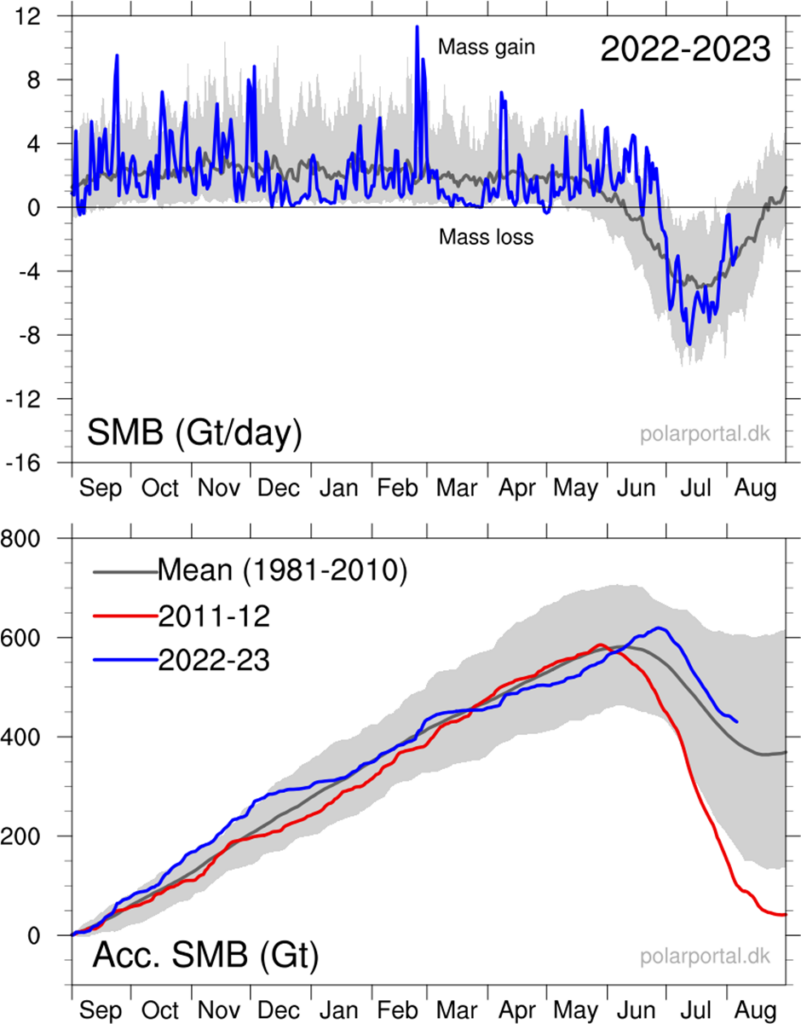
If the Mail is “shocked” by how much the Greenland ice sheet has melted this year, it probably didn’t consult the polar portal site run by Danish meteorologists, which updates an accurate record on a daily basis. Both graphs above show the effect of a cold June where the ice loss was considerably lower than the previous year. Warmer weather arrived from the south in late June in time for the peak summer melt season.
As the second graph shows, the accumulation of surface ice on Greenland is more than the 1981-2010 average, and a big improvement on a decade ago. But as the Daily Sceptic noted recently, the current improvement can be seen in an even better light. A number of scientific institutions still use a decadal 1981-2010 average for comparison purposes, despite data to 2020 being available. The cynical might note that the ice sheet lost just 51 gigatonnes a year in the 1980s, compared to an annual loss of 244 gts in the 2010s. Updating the average figure would greatly amplify the recent, and continuing, recovery in the surface ice mass.
The ”shocking” before and after photos revealing how snow melts in the summer, even in Greenland, were taken by NASA satellites over the Frederikshab Glacier running down to the warmer south-west coast. The information and photos came from a NASA blog aimed at educators headed ‘Wasting Away (Again) in Greenland‘. More than halfway through the 2023 melting season, reports NASA, “Greenland has seen a substantial transformation of its snow cover”. This line – if it’s summer in Greenland, the snow melts – is readily taken up by the Mail. “According to scientists, snow falls on the Greenland ice sheet every winter… but experts say hotter summer temperatures are reducing the amount of snow cover.” The NASA blog is heavily quoted: “More than halfway through the 2023 melting season, Greenland has seen a substantial transformation of its snow cover. … Changes are the result of the increasing warmth of summer weather that took hold across the region in late June.”
Hold the front page – snow melts during the summer in Greenland, not many dead.
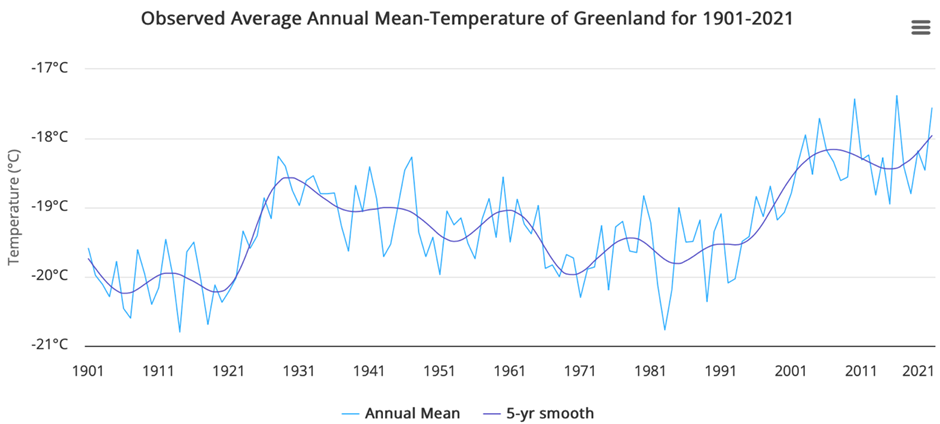
It is not difficult to find areas of rock in Greenland, especially in the south-west where most of the population of 55,000 live. The climate in this area is characterised as ‘low Arctic’ and temperatures are well above freezing in the warmest months. Ice in the Arctic waxes and wanes on a cyclical basis, while the long-term Greenland temperature is fairly stable. At a time when the planet has seen a gentle period of warming over the last 100 years, Greenland even held back slightly on the general trend. The five-year moving average of -18.57°C in 1929 compares with a measurement in 2021 of –17.96°C. The largest boost, as with other areas of the world, occurred in a short period in the 1980s and 90s, as the World Bank graph below shows. Since that time, as elsewhere, the rate of warming has considerably declined.
The Greenland ice sheet is the alarmist scare story that keeps on giving because water flowing off the land can increase sea levels. The Mail notes that scientists have already warned this year that the Greenland ice sheet is the “hottest it has ever been” and will cause global sea levels to rise by 20 inches by 2100 if it keeps warming at the same pace. In fact this information is linked to an earlier article that referenced a science paper quoting temperatures between 2000-2011. The next paragraph of the current story reports a rise of four feet or 1.2 metres by 2300, “even if we meet the 2015 Paris climate goals, scientists have warned”. Scientists might “warn”, but all these opinions of greatly increased sea level rises are produced by climate models, often assuming outlandish future scenarios.
Again, as we have noted in numerous articles, sea level rises are notoriously difficult to calculate since land rises as huge weights are lifted from it. Many areas in the northern hemisphere show falls in coastal sea levels, and this process is ongoing since the Earth is currently in an interglacial phase. In fact, current rises of 2mm a year are tiny compared with the huge boosts between 12,000 to 4,000 years ago.
Again, hold that front page – shock 2mm annual rise will lead to civilisation being inundated in the next century by a catastrophic seven inch increase in sea levels. Not many expected to die.
Chris Morrison is the Daily Sceptic’s Environment Editor.
To join in with the discussion please make a donation to The Daily Sceptic.
Profanity and abuse will be removed and may lead to a permanent ban.
How can you expect journos to cope with a report containing so many numbers and charts. They are mostly journalism and sociology graduates who don’t know any maths.
Here’s an indication of how well the BBC’s most highly-paid current affairs presenter, Stephen Nolan, AND Northern Ireland’s Chief Medical Officer, Professor Dr Sir Michael McBride – AND even FactCheck NI (see below) – understand numbers: This is an exact transcript of an interview with Professor McBride on BBC Radio Ulster’s Nolan Show in January 2022 when Omicron was rampant: Nolan: “Let me make sure I’m understanding those figures: You talked about a 50% protection there, after how many months?” Professor McBride: “That’s after six months with two doses of the vaccine.” Nolan: “So if you come across Omicron, if you’ve had two doses and you haven’t had your booster, you’ve a 50-50 chance if you get Omicron of ending up in hospital, is that what you’re saying?” Professor McBride: “That’s correct, that’s correct.” Nolan: Wow!… …Nolan: “With all due respect to you, and, you know, anything I say this morning, I think if we can drum home the message to people listening this morning, if you’ve had two doses of the vaccine, and you haven’t had the booster, if you get Omicron you’ve got a 50-50 chance of ending up in hospital. That is an incredible statement and it… Read more »
At the risk of boring folk,–a very short history lesson. The RAF had a staging post in the Maldives, 42 nautical miles South of the equator at 73degrees 10mins East. It was located on Addu Atol and was closed by the then Defence secretary: ‘Sleepy’ Fred Murray in 1974/5.
Fast forward to today and its been developed as an upmarket holiday destination costing big bucks to stay there. We aircrew regarded it as a ‘chore’ spending time on Gan as we were itching to get to Singapore or Hong Kong to sample their delights for a few days.
Gan was and had been for decades, 6ft AMSL (above mean sea level)- Checking up to date charts, it’s still 6ft AMSL.
You can’t say things like that.. you’ll be cancelled and sent to the Maldives to labour on one of their new airports.. 😉
Our schedule meant we’d land at Gan at 2am local time having flown for 8 hours in the VC10 (hence my cognomen) from RAF Akrotiri in Cyprus. Gan being on the equator, day and night temperatures varied little, 25c night time, 30c or so day time. It was always ‘beer o’clock’ once we’d landed and handed the jet onto the next crew who’d take it on to H-K to hand on to the next crew for the return journey.
We’d sit in the air-conditioned lounge in the transit facility, know as The Blue Lagoon, supping away and shooting the breeze before bed at around 5 or 6am. Bemoaning our fate of 3,4 or even five days stuck on the atoll, occasionally, some spark (normally an ancient old, wise Air Engineer) would opine, “we’ll miss all this when it’s gone you know.” How right he was!
Happy days from 50 years ago.
When did facts ever become an obstacle to a bunch of liars? Put a suit and tie on, adopt a grave demeanour, speak English slowly and sombrely in a foreign accent and give yourself a title like, um, UN Secretary General for instance and the world’s press has a collective spontaneous orgasm over every serious pronouncement you make. Fear sells news after all.
Not bored at all. Ver interesting. You could have told us about the “delights” you missed out on though!
Bugis Street, Singapore and pick any nightclub on Nathan Rd. Kowloon including ‘Bottoms Up’, not far away. That’d keep you occupied for a while Bill, ‘back in the day.’
Willis Eschenbach wrote an interesting paper a few years back about atolls.
Briefly, he noted:
“Regarding atolls and sea level rise, the most important fact was discovered by none other than Charles Darwin. He realized that coral atolls essentially “float” on the surface of the sea. When the sea rises, the atoll rises with it. They are not solid, like a rock island. They are a pile of sand and rubble. There is always material added and material being lost. Atolls exist in a delicate balance between new sand and coral rubble being added from the reef, and atoll sand and rubble being eroded by wind and wave back into the sea or into the lagoon. As sea level rises, the balance tips in favor of sand and rubble being added to the atoll. The result is that the atoll rises with the sea level”.
https://wattsupwiththat.com/2010/01/27/floating-islands/
If the last sentence is correct Dickie, then Maldivians have nothing to fear. They’ll never be submerged. A good thing.
From memory, Gan, (Addu Atoll) is something of an oddity amongst its hundreds of neighbours in that it’s central lagoon is formed from a volcanic crater (Seamount). Aerial shots of it show this vividly.The main islands around the rim (four from memory) allow access to shipping as well as shelter, hence why Gan was a Royal Naval base well before the RAF got in on the act. I can certainly attest to a feeling of misgiving when snorkelling away from the inner rim towards the lagoon centre. White sand, coral and pretty aquatic life gives way to an impenetrable black gloom directly beneath one, allowing the imagination to conjure up all kinds of possible ‘Spiny Normans’ below. Rumour had it that the caldera depth was several hundred metres.
You genuinely write beautifully 10N. Could hear your tales over a few cold ones for hours.
Thank you jeepy. I owe it to my English master in Burnley, a Mr Housby.
58 years ago, I came out with a trite comment in his class, for which he slapped me hard across the face and said, “one day Lee, you will regret speaking like a yob!”
I took his words to heart and acted on them. I was commissioned in the RAF four years later.
It’d never happen today.
Greenland is less than <8% of total ice volume on the planet. Even if it did melt, which it obviously is not, nothing would happen to sea levels in reality. Just compare ocean volume with Greenland sheet volume (it is a mole fraction). However the quacks aka scientists with models, predict that if it does melt there will be 23 feet or more of rising seas from the plant food! Must the $cience and fear porn. https://climate.nasa.gov/faq/30/if-all-of-earths-ice-melts-and-flows-into-the-ocean-what-would-happen-to-the-planets-rotation/
It is not going to happen, but you might want to check your calculation. The total surface area of water on earth is about 360 million sq km. There are about 3 million cubic km of ice on Greenland. Therefore, if it all melts sea levels will rise about 3/360 km = 0.008 of a km = approx 27 feet.
‘Fraid not, MTF.
All the oceans ain’t in a neat column of uniform depth so your simple calculation won’t do.
Pour a measure of gin into your cocktail glass and note the depth at the centre. Pour a second measure into your glass and check the depth again; it isn’t doubled, is it?
Get it?
Oops. Just reread your comment MTF – worse than I thought, you made the schoolboy error of confusing square and cubic measure. It’s really easy to see why you can’t do that.
Read my example above carefully and I think you will retract that comment.
You are over complicating things. The volume of the sea is immaterial. All that matters is the area at the surface.
Take that glass of gin. Suppose the area at the surface is 10 sq cms. Add 5 ccs of gin into the glass. The level will rise by 0.5 of a cm – it doesn’t matter how much gin was in the glass to being with. If you don’t believe me try it 🙂
Hi MTF
Only if the surface area is constant at every level. Think again about a cocktail glass 🍸.
In my example, every addition to the volume in the glass (oceans) increases the surface area of the liquid.
Thus the depth is increased by a lesser amount each time an additional unit of volume (cc or km3) is introduced.
Try it.
I see – we are talking at cross purposes. I was confused by the reference to “columns of uniform depth”. Depth has nothing to do with it.
Of course there would be a slight reduction in the height gain as the surface area expanded but it is a minor effect. Even if the whole earth were covered in sea the addition of 3 m cubic kms would raise the height by nearly 20 feet.
Yet more death by climate from the MSM, utter rubbish, distortion and cherry picking of facts to for fil an agenda. Reuters this morning have an article about Antarctic sea ice melting due to massive rises in sea temperatures. No mention of volcano activity, no mention of ice gain either, just more distortion of facts to fill the narrative and fear.
Has anyone noticed that the met office now give out a yellow severe weather wind warning for a stiff breeze? It is almost as if, if you cannot sit out side comfortably and use your laptop, the weather must be severe.
‘The time has come, the Walrus said, to talk of many things:
Of shoes and ships and sealing wax of cabbages and kings,
Of why the sea is boiling hot and whether pigs have wings.’
Lewis Carroll clearly predicted the UN’s current pronouncement and suitably that was a work of pure fantasy, just like the UN. Nowadays, they don’t seem to make any effort at all about facts because all the fact checkers are on their side and the media too. No, they can say what they like and the sleeping billions will lap it up and regurgitate it as ‘the twuth’.
This summer my sun shade has remained in its winter cover and my outdoor furniture is almost completely unused after a couple of days use in spring.
My Victoria plum has masses of fruit, but it is in the main quite unpleasant to eat raw. Apparently plums need a lot of sunshine to become sweet, but no chance this year. Last year they were succulent and juicy.
Apparently Northern latitudes have been unseasonably cool this summer, and you have to go closer to the Equator to get heat (especially if you report the ground temperature).
If I am not mistaken, Greenland is somewhat northerly too.
In other news, heat pumps are better than gas boilers, the government is solving the migration crisis, raising interest rates compensates for backfiring sanctions, Ukraine is winning and Biden is so good at his job that he can holiday for half the year.
PS I forgot that banks are all very keen to help their customers.
Thanks for the chuckle, it was most welcome this morning. The information regarding temperature was interesting, who would have thought it was warmer nearer the equator?
Yes, the idea that banks are very keen to help us and will do everything they can possibly do to make sure cash is available.
“It’s our hope that we can continue to ensure that the public has access to cash,” said a bank spokesman somewhere as the bank closed down another twenty branches and reduced the daily amount of cash a customer could withdraw…
Whose afraid of the big bad melt ? ————–Practiacal Politics is about scaring the population with an endless series of hobgoblins (all of them imaginary) so people are clamouring to be led to safety.” Mechelen. ———-Climate Change is just the latest hobgoblin, but isn’t a real whopper? The biggest baddest meanest pseudo scientific fraud ever perpetrated on an unsuspecting public who think it all about “following the science”. If you believe that then there is no hope for you. Maybe once your gas central heating has been ripped out and you are sitting in a bus like you were in the former Yugoslavia you might finally say to yourself “Hey wait a minute, I thought the sea levels were all rising duh”
According to the weather forecast of yesterday, it should be dry with sunny intervals in Reading today. I got up shortly after 8am and by then, it was raining. The rain probably stopped about an 30 minutes ago. As the cloud cover is unchanged, it may well start again at any time. The met office changed its forecast to Drizzle changing to overcast in the afternoon, the BBC to Thundery showers and a gentle breeze. These people cannot really predict the future weather for the next 24 hours. Why does anybody believe in their forecasts for the next 50 years?
The same idiots also like to bang on about the West Antartic ice sheet melting – with calving of icebergs the size of Wales and retreating glaciers. The following articles both appeared in the Guardian.
In the 2017 article, it announced a huge number of undersea volcanoes discovered in West Antartica.
In the 2023 article, it states: “scientists said the finding, based on sea floor sediment formations from the last ice age, was a “warning from the past” for today’s world in which the climate crisis is eroding ice sheets….. Cognitive dissonance – alive and thriving within the “house newspaper of the Civil Service and BBC”.
https://www.theguardian.com/world/2017/aug/12/scientists-discover-91-volcanos-antarctica
https://www.theguardian.com/environment/2023/apr/05/ice-sheets-collapse-far-faster-than-feared-study-climate-crisis
A 2 mm a year sea-level rise is in fact very significant, as the decades move on – nearly a foot a century. There is plenty of property in the British Isles which would be under threat in the face of such a rate of rise.
And why do sea levels appear to have been pretty constant for centuries but at the end of the 19th century began to rise quickly, a rise which has accelerated over recent decades?
I’m not saying this is definitely global warming, let alone man-made global warming, just that it cries out for an explanation.
End of medieval mini ice age. Many locations in the UK that were medieval ports are no longer. Sea Levels vary by coastline and region and many factors are at play. Plant food from hydrocarbon energy is not one of them.
End of medieval mini ice age
I guess you mean the Little Ice Age? By most interpretations it came to an end about 1850, which would tie in with rising sea levels from a few decades later.
So yes, ‘End of medieval mini ice age’ is my favoured hypothesis at the moment.
But it’s no good simply denying that sea levels are rising, just because it doesn’t fit with the climate-change sceptic narrative.
And I’d hazard a guess that anyone who assumes a sea level rise of 2 mm a year is trivial and doesn’t matter, as the author of this piece apparently seems to think, has never lived in a low lying coastal environment or seen what very high spring tides and storm surges can do.
Good to see opinion from both sides expressed without ad hominem nastiness. Two points: 1) Is Ferdill “simply denying” that sea levels are rising? I agree with you that simple denial would be foolish, but as far as I can see, his view can be summed up in his assertion that “many factors are at play”. I don’t see this as denial. 2) You imply that the author of this piece might think differently about sea level rise if he lived in a low-lying coastal environment; I don’t think he would – assuming he’s a good scientist – and it’s a little mischievous to suggest he would. (Most) readers of this column are concerned with the evidence as represented by the MSM and the role (if any) played by human activity, not with the consequences of climate change. But concern with quality of evidence does not imply lack of concern for human beings living in vulnerable environments. That said, the simple reality is that people have moved into and out of the path of natural dangers since the dawn of time. The implied accusation of thoughtlessness here is a red herring; the author thinks about potential danger to life all… Read more »
Fair comments. I wasn’t actually implying that FerdIII was denying sea levels are rising, just that many people either are or are choosing to ignore it – which I struggle to understand of a sceptic of any persuasion. To deny that sea levels are rising is to me akin to deny that the stabs have caused a very many side effects. And if sea levels are indeed rising then we need to ask ourselves what is causing it. For my own part, I doubt it’s man-made global warning, but I can’t be sure. In his last paragraph the author of this piece scoffs at the idea of a mere 2 mm sea level rise a year. Sorry, I don’t agree. I think this matters a great deal. I’m not trying to score any points here, still less to get into any ad hominen attacks – I’m just trying to understand what is going on – and right now I don’t. In which case any true sceptic would start asking questions. FerdIII and RW have both come back with good points, but there’s a load of downvotes on my original post and comparatively not a lot of discussion, which I find… Read more »
Bit puz
Tried to reply to TJN but not being allowed to. Don’t know why. Will try later.
One or two things to say in response to that, but before I do, can you explain the second part of this sentence (from “akin to”):
“To deny that sea levels are rising is to me akin to deny that the stabs have caused a very many side effects.”
A typo or two?
I’m trying to say that as sceptics we must consider all the evidence, whether it fits our preferred narrative or not.
If we ignore evidence we don’t like, aren’t we on the same level as those who’ve denied the vaccine harms?
I don’t think we can just dismiss the current sea level rises as being insignificant or of no matter. Indeed, if we can believe the tide-gauge data, sea levels currently appear to be rising as fast as or faster than at any time for several thousand years. Why?
I’m genuinely trying to get at the truth here. I actually want to understand why sea levels are rising.
I’d be delighted if Chris Morrison, or anyone else, would explore this topic.
Going to be offline quite a bit from now, so apologies not replying promptly.
Yes yes – plenty to say in response to that; for now I just want to know what that phrase means: “…is to me akin to deny that the stabs have caused a very many side effects.”
??
Not trying to needle – just need clarity before making other points. I’ll wait till you’re back.
is to me akin to deny that the stabs have caused a very many side effects
First of all, I meant ‘denying’ – sorry, my typo.
What I’m trying to do here is cite an example, which many on here will be familiar with, of a group of people who have denied evidence that is staring them in the face simply because that evidence doesn’t fit what they want to believe. The vaccine fans just can’t face up to the fact that their potions have been neither safe nor effective, so rather than addressing any evidence which points that way they ignore it.
For me, for climate change sceptics to deny that sea levels are rising, comparatively quickly, amounts to a parallel fault – denying something because it doesn’t fit their narrative.
Offline again soon – I’ll recheck this thread in the morning.
Yes, and before that we have records of the hot stuff. Some streets in London remind us. Grape Street and Vine were thus named because in Chaucer’s time they grew black grapes In Covent Garden.
Yes, and before that we have records of the hot stuff. Some streets in London remind us. Grape Street and Vine Street were thus named because in Chaucer’s time they grew black grapes In Covent Garden
Yep, Medieval Warm Period, c. 950-1250, followed by a period of storminess and cooling through the Little Ice Age, after which warming recommenced in the nineteenth century.
Climate change has always been with us.
Large parts of Belgium and the Netherlands are below sea-level and where actually sea not that long ago. Surely, building a 2 feet dike every 100 years cannot be so difficult. That makes 20 feet per millenium which is still lower than dikes on the continental North Sea coast already are (and have been for centuries).
BTW, your estimate is way off — it’s 200mm per century which is less than 8″.
it’s 200mm per century which is less than 8
Yep, sorry – you’re quite correct. I was thinking of the latest data from the tide gauge at Newlyn in Cornwall which is actually giving over 3mm per year rise (3.8mm overall in recent decades, including 0.7 mm isostatic rise).
https://nora.nerc.ac.uk/id/eprint/512368/7/A%20Century%20of%20Sea%20Level%20Measurements%20at%20Newlyn%20Southwest%20England.pdf
Page 126
But surely increasing flood defence heights by 1 foot costs an enormous amount? And what about all the low-lying coastal towns and villages which currently have no protection but will become unviable without some barrier? How much will that cost?
What would it cost to add a foot to the Thames Barrier?
Another example: the Exeter to Plymouth (and hence Cornwall) railway by Dawlish-Teignmouth. How can that be protected from even a foot sea level rise?
My guess is that the construction of effective protection throughout southern England against a 1 foot sea level rise would be hellish expensive.
As I already wrote in the previous comment: Large parts of Belgium and the Netherlands were originally part of the North Sea and were (sort of) conquered from it by successive dike-building projects since the middle-ages. Apparently, the value of the land gained in this way was worth it. In any case, it’s technically perfectly doable.
Yes, I think that’s a fair comment – clearly it’s feasible. Yet my guess is it’s far from trivial, and that say a foot sea-level rise in this country will cause major hassle. That’s my main point – that 2 mm a year doesn’t sound like much, but eventually it is.
On the broader climate question, we have to ask why sea levels have been rising since the late 19th century. As FerdIII alludes to above, my guess is that it’s the warming since the end of the Little Ice Age. But I doubt there was much human induced warming in the 19th century, when the current cycle appears to have started.
Yes, I think that’s a fair comment – clearly it’s feasible. Yet my guess is it’s far from trivial, and that say a foot sea-level rise in this country will cause major hassle. That’s my main point – that 2 mm a year doesn’t sound like much, but eventually it is.
That’s doubtlessly correct. At this extreme rate, it’ll take only about 430 years until flood defences in Britain will have to match common flood defences in Germany (dyke at Friedrichskoog on average 8.6m aka 28’3″ above sea level). That’s clearly too little time and too much of a technical challenge for mankind to cope with!
[sarcasm intended]
Weather pattern variation is not the only cause of sea level change with respect to coastal sea levels. The tectonic plates move a bit as well. https://education.nationalgeographic.org/resource/plate-tectonics/
Yes, that’s a fair point, there’s lots of other factors which affect sea levels.
Sea levels have not be constant throughout history.
They have risen and fallen throughout the past.
Climate change has occurred for millions of years naturally.
There is no evidence that current climate change is caused to any any major degree by humanity.
Computer models are not evidence.
Climatology is very complex and it ir vey premature to say with any degree of certainty that humanity is the cause of current climate change.
I’d go along with all of that.
There is no doubt about major disruptions in weather patterns but for the most part I attribute these to human inerventions. If we had an environmental movement free of this corporate crap then I would support it. This is the really insidious part of this agenda – they aim to replace genuine concern with faux concern.
Great article
The graph of Greenland average temperatures has been heavily adjusted to fit the global warming narrative. Various unadjusted data sets from individual weather stations in Greenland, supplied by DMI, show temperatures in the 1930’s were as high as current temperatures.
Glaciation depresses the earth where the glaciers are.
Once the glaciers melt the earth slowly rebounds in that area.
This is currently happening in the Hudson Bay area of Canada.
If the glaciers melt in Greenland similar earth rebound/rise will occur.