
People with Better Environmental Knowledge Suffer Less ‘Climate Anxiety’
Back in December, I covered a study that found no correlation between intelligence and attitudes to climate change: Europeans of higher intelligence were neither more nor less likely than those of lower intelligence to take the ‘alarmist’ position on that issue.
A new study by Hannes Zacher and Cort Rudolph brings a similarly intriguing result.
In October of 2022, the researchers gave an environmental knowledge test to a sample of about 2,300 Germans. The test comprised 35 multiple-choice items. (It is given in full in the Supplementary Material for this paper.) One of the items is shown below:
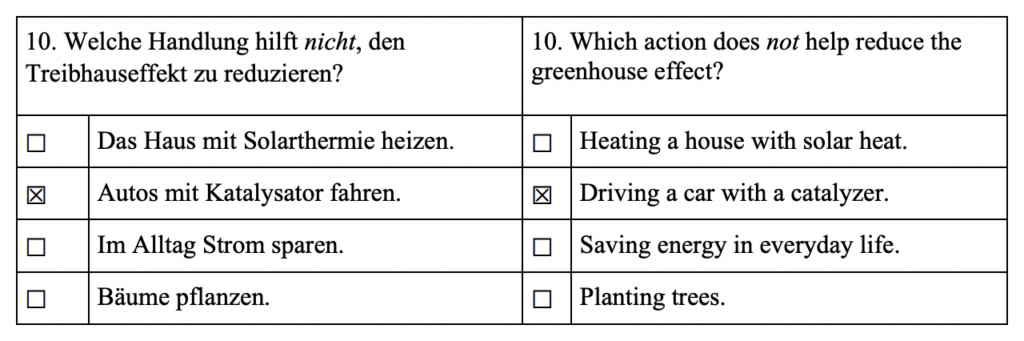
The correct answer is shown with an X. Other items included, ‘What is the meaning of the abbreviation CO2?’ and ‘Which energy form is a renewable form of energy?’
One month later, the researchers asked respondents to complete a 13-item measure of ‘climate anxiety’. (About 2,000 of them took part in both waves of the survey.) Items included ‘Thinking about climate change makes it difficult for me to concentrate’ and ‘I find myself crying because of climate change’. All 13 are listed below:
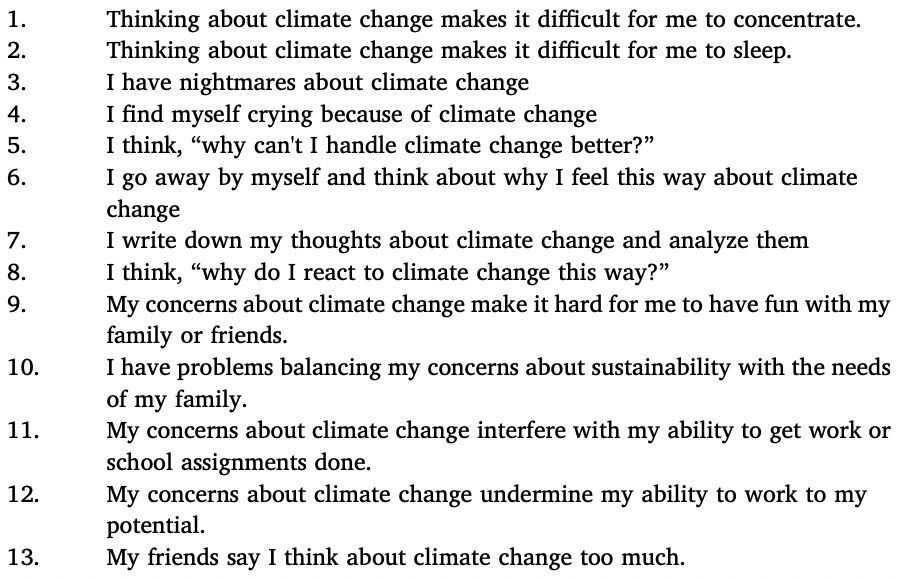
So what did Zacher and Cort discover? There was a moderate, negative association between the two variables (r = –.34). Respondents with better environmental knowledge scored lower on the measure of climate anxiety. The association is shown in the chart below:
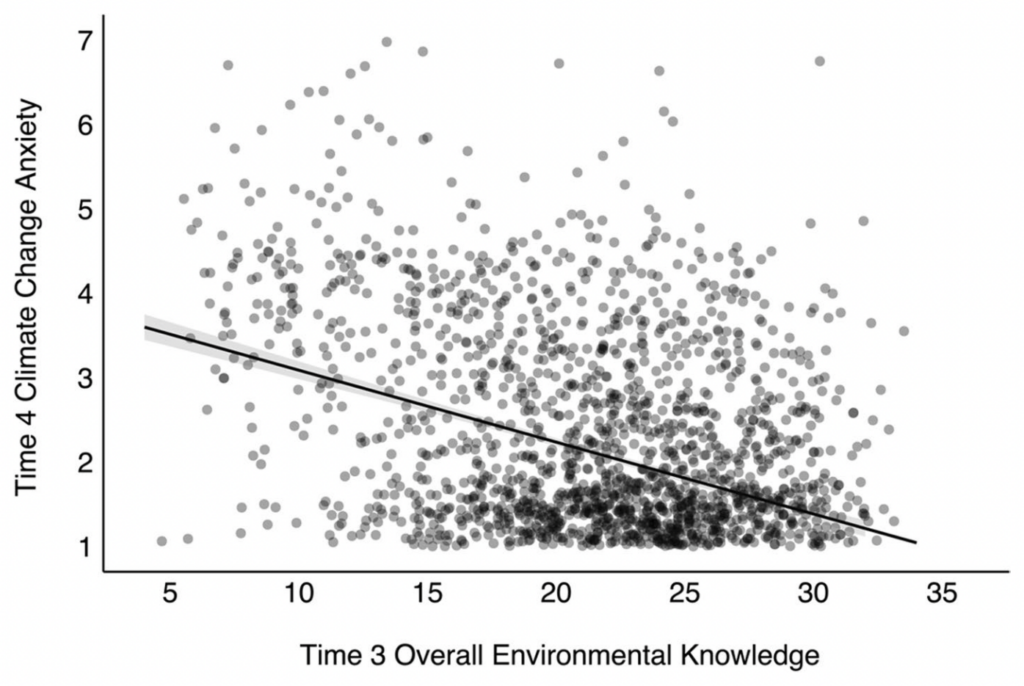
You might say, “the cloud of points is a mess”, but that’s just what a correlation of r = –.34 looks like. Interestingly, when the researchers examined climate knowledge in particular, they found that that too was negatively associated with climate anxiety. Respondents with better climate knowledge again scored lower, although in this case the correlation was somewhat weaker at r = –.24.
Environmental knowledge remained a statistically significant predictor of climate anxiety even when the researchers controlled for basic demographic characteristics, measures of personality, and a measure of pro-environmental attitudes (i.e., believing we should do more for the environment) in a multivariate analysis.
It should be noted that pro-environmental attitudes did have a positive association with environmental knowledge, though the correlation was very weak (r = .15).
Overall, Zacher and Cort’s study suggests that anxiety over the issue of climate change does not stem from greater knowledge of the environment or of the climate in particular. In fact, the most knowledgeable people are somewhat less anxious, on average. As the researchers point out, this suggests that improving people’s knowledge could help to reduce anxiety – particularly among the young.
To join in with the discussion please make a donation to The Daily Sceptic.
Profanity and abuse will be removed and may lead to a permanent ban.
I dont suffer any climate anxiety, I suffer from the politicisation/perversion of climate science.
I suffer from climate catastrophist anxiety every time one opens its mouth. It worries me that anyone could be so duumb.
It worries me what authoritarian or totalitarian idea they’ll come up with next!!
You beat me to it !! 👍✅
Ignorance and the willingness to believe what you’re told is probably the strongest link. Ignorance of a particular topic can – and does – happen in tandem with being highly intelligent. Look at some of the “experts” of whatever!
The “experts” know that they are lying, and they know that we know that they are lying – without the lies the research funding dries up.
People who understand that there aren’t any major problems are certain to be less anxious.
Thinking about natural climate change makes my mind boggle at the wonders of the universe and how all things are interconnected.
Thinking about ‘manmade’ climate change makes me laugh at the human race’s ability to delude itself at the behest of doom goblins and crooks like George Soros.
Well, yes. Of course, there are many man made things that can help us to cope with climate change (which is normal), and more to the point, extreme weather outcomes. But, as is often the case, money says no, until something has actually occurred and then the financiers have to do the sums again. E.g. in the last decade or so, remember what happened on the railway between Newton Abbot and Teignmouth, or the Somerset Levels flooding, overflowing rivers like the Severn, the Wye and so on.
There is no manmade climate change. It’s a gigantic fraud and ‘climate anxiety’ is the result of brainwashing the public with fake news!
Wait, what?
There are people who answer yes to any of those 13 questions?
Unfortunately, yes. Almost certainly the suggestions were offered with a 10 point scale along the lines of ‘strongly agree’ to strongly disagree’. I note the bias in that there are no suggestions offered which could be chosen to indicate no concern or disagreement with the theory of man-made climate change.
Still, it’s useful stuff. ‘Know your enemy’ and all that.
Well they tried to validate the questionnaire in this paper and were disappointed to report that,
“Overall, people reported low levels of climate anxiety.”
https://link.springer.com/article/10.1007/s10584-021-03234-6?error=cookies_not_supported&code=5106e307-4070-4953-941c-58d72ad5fe2e
Yes. The opening sentence reads:
So, not biased at all.
It’s getting better in the introduction:
The climate crisis represents an existential threat to human well-being and survival. Its effects on (non)human ecosystems are tremendous and surpass previous predictions substantially.
The last climate prediction I remember was from last year August. It was Because of climate breakdown, the weather will remain dry for months to come. A few days later, seriously above average rainfall started and continued until December.
I suffer net zero anxiety.
I suffer Big State Anxiety. Candace Owens talked about this on her show a couple of weeks ago: how she and her husband are beginning to think the best thing they can do is take their kids and flee somewhere remote, away from much of civilisation. I think a lot of us feel this way. Rather than any climate catastrophe bearing down on me, I feel Big Government totalitarianism creeping into my home ready to confiscate and/or destroy everything I’ve ever loved in the name of its warped ideology. A little over three years ago, I had no idea just how horrifying a totalitarian government can be. Now I feel it everywhere and I fear for the future.
Exactly what I mean.
What I find interesting is the generally low level of anxiety for an issue said to be a threat to life on earth.
Its quite geographically localised, and the equation seems to be something like, where ‘climate change is an existential threat’.
Disposable income
—————————-
Ability to think critically
Feel free to finesse this idea…we’re breaking new ground….
That’s because it isn’t a threat to life on earth.
I haven’t got a clue what this is on about.
r =……. ????..
r refers to correlation. A correlation statistically is always between 0 and 1, or, for a negative correlation (a correlation in the other direction), between 0 and -1. r = 0 means no correlation whatsoever. r = 1 means a total correlation. The closer the correlation (r) is to 1, or to -1, the stronger the correlation. In the case of anxiety about climate change, one might expect that the more a person knows about the supposed danger to the environment, the more anxious the person is likely to be, if the danger is real. But this study shows that the opposite is true, there is a moderate but statistically significant correlation in the other direction, a correlation of r = -0.34 (minus rather than r = +something) meaning, as the headline states, that the more a person knows about the environment, the less anxious they are about climate change. Perhaps the more a person knows about the environment, the more faith and hope they have in science to solve the problem of climate change, or perhaps the more a person knows about the environment, (as ‘LaptopMaestro said above) “people who understand that there aren’t any major problems are certain… Read more »
I like that this study suggests that ‘women experience less climate change anxiety when men’
You shouldn’t be anxious about the future but you should be pissed off about it because Spring is going to become later and later so that it hardly exists at all and you will see the same truncation in the autumn. I don’t like it and frankly I wish I was born into a third world slum as long as it was warm but you have to be realistic about the future its no joke. They know about the low energy period that is coming and we should be mindful about this. This is the greatest reality facing mankind in the northern hemisphere and it will last a long time. If people acknowledge a bad situation and work together to deal with it then it can be a happy time and a time of introduction and recognition. Just be aware of this as an underlying reality that is going to affect everything else.
If anxiety is on your list of concerns given the future that is coming then you are screwed. Oddly enough though, people with deep depression might be well served. It is a different time that is coming. Not a great time in our culture’s history but nonetheless someting very different.There will be no return to a high culture. T.S. Eliot said that western culture would retreat back into the monasteries very soon (after the 1950s). I suspect that the highest ideals will attempt to do that. I would say don’t give up on the west just yet. According to Jung we still have forces that can keep our culture alive. Firstly the myth of the grail and the idea of the male in the female and the female in the male. This has nothing to do with transgender issues. The true acknowledgment of where we are now.
Like Dudley Moore said, my mom came into my room and sucked my tiny knob. Look it up if you don’t believe me because until recently it was on Youtube,.
I don’t suffer from climate anxiety at all, I suffer from climate activism anxiety….
What are they going to do next to make people’s lives miserable?
You see a lot of activists being invited onto TV News, eg Mogg has a few of them on his GB News show, and some are students which means you would think they would have intelligence. They certainly have enough intelligence to speak about the issue as they see it, but do not seem to have the intelligence to investigate further than their own bias.———————– I have noticed that when Mogg or other presenters put questions to them that the wheels in their brains, polluted by confirmation bias, are turning only concerned with what they are actually going to say next rather than apply themselves to the question put to them. They make claims of certainty where there are none. They take worst case scenario’s from computer models and assume that to be some kind of ultimate truth. They can be summed up by the following quote “Fools and fanatics are always so certain of themselves, but wiser people are so full of doubts”
Proof that NPCs are mince