
How Much Is Britain Spending on Energy Subsidies?
It’s cold here in London, and it’s getting harder to resist the temptation to turn on the heating. Which prompts the question: how much are these high energy prices costing the country?
Some data are now trickling through. The British government recently released figures on the state of public finances, and they make for grim reading. In December of 2022 the UK government borrowed more money than it had in any other December since records began in 1993.
Driving this borrowing were two things: higher interest rates and energy price subsidies. The latter are included in the line item ‘Subsidies (Other)’ on the government balance sheet. Here is that line item, in billions of £s, for the third quarter of fiscal years 2021 and 2022.
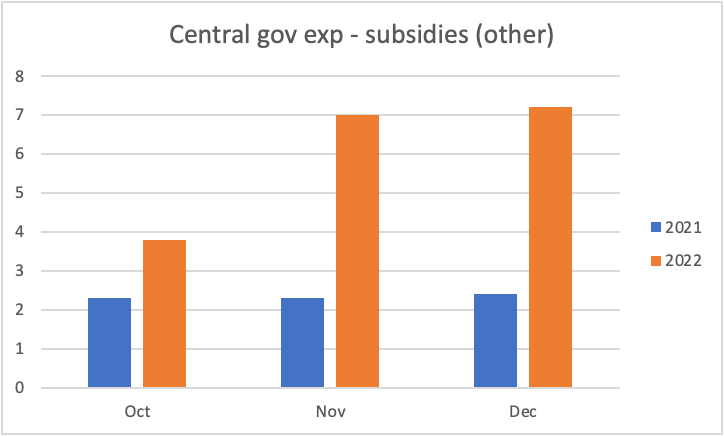
We can estimate from this that in the third quarter of fiscal year 2022, the government borrowed around £11bn to spend on the energy price guarantee. Taking the December numbers alone, for every £12 the government borrowed £1 was spent on the price guarantee.
Now, the Modern Monetary Theorists – who it must be said, with COVID-19 and the chaos in energy markets, are having a good decade so far – will tell us that since the UK issues its own currency, it can borrow as much as it likes. There is some truth in this. Nevertheless, if the UK borrows and spends and this money flows abroad it will (all else being equal) put downward pressure on the price of sterling. If sterling falls, the price of imports rise – and real wages fall.
With a little statistical manipulation, we can use the government borrowing data to estimate the current account – the amount of money flowing into and out of Britain.
The Department for Business, Energy and Industrial Strategy informs us that without the energy price guarantee, the price of energy for the average home would be £4,279. Since the price guarantee ensures the average household pays £2,500, we can infer that the government is covering around 42% of the current energy price. This implies that for the £11bn the government spent on subsidies in the third quarter there was an additional £15.5bn spent by households. This means that the total spent on energy in this period was around £26.5bn.
Now we can use this estimate to estimate the current account. Britain imports around 50% of its gas. So let’s assume that around half of this £26.5bn was spent on imports. That gives us an estimate of the British current account in 2022 as follows.
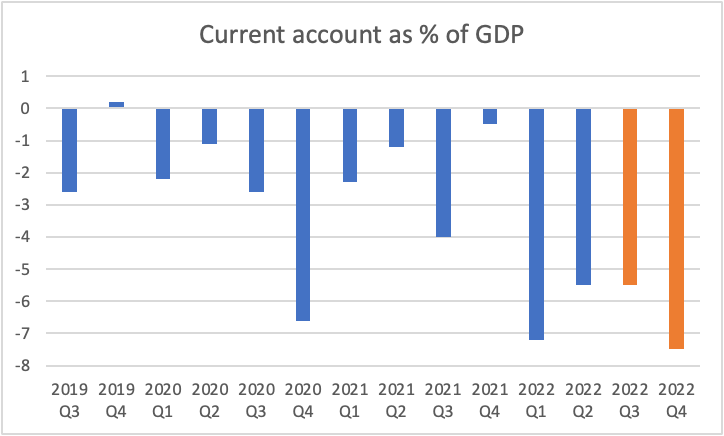
It is easier to compare this data annually. The chart above implies that in 2022 the British current account deficit will be around 6.4% of GDP. This would be the largest current account in British history – the previous two largest being 5.5% of GDP in 2015 and 5.2% of GDP in 2013.
The country has managed to sustain this current account so far with only some disruption to sterling. But can it sustain another year of this? That is far from clear. Yet many are predicting that 2023 will be a worse year for energy prices than 2022, since Europe had access to six months of Russian gas last year and won’t have any this year.
Of course, these are all just estimates that require us to make various assumptions. What is clear is that the government borrowing data for subsidies implies a substantial increase in the amount of sterling flowing abroad to buy energy imports. Which doesn’t bode well for Britain’s finances.
Philip Pilkington is co-host of the Multipolarity Podcast. You can follow him on Twitter here and subscribe to his Substack newsletter here.
To join in with the discussion please make a donation to The Daily Sceptic.
Profanity and abuse will be removed and may lead to a permanent ban.
370 billion spent on unnecessary pandemic measures whilst shutting down economy.
What could possibly go wrong…?
Unless the State and it’s expenditure reduce drastically it is simply not sustainable.
Has anyone else noticed the £’s value is not that much different from the value during that ‘mini budget’ from Liz Truss?
About 20% stronger versus USD, a significant move in fx in just 4 months.
23rd Sep it was 1.12, today its 1.23
What is missing in this piece is how much is being given away to the companies supplying renewables.
Exactly how much of taxpayers money is being wasted on the whole of the renewable industry. Once we have this information we can make a proper assessment of the crimes being committed by government against its people.
There is no excuse for giving taxpayers money to renewable companies in order that lying ministers, and Bozo, can tell us what a success their green revolution is turning out to be.
We are being deliberately lied to and deliberately impoverished not because any of these Next Tuesdays believe the climate crisis crap, they don’t, but because the aim is to take this country back to a feudal existence with a feudal size population.
Indeed, even if we’re to believe it’s all prim and proper, what scrutiny do any of these climate related projects adhere to and come under, once in the bowels of bureaucracy. I presume there’s much to be gleaned from UK Column’s FCO spending search engine, if only to know how it’s been catalogued and with which company.
https://fcdospending.ukcolumn.org/
I see silly people wheeled out on News Programs talk of the “switch to renewables”. ——But renewables only provide electricity, which is only one fifth of our energy needs. For the 22 million households with gas central heating, renewables cannot heat your radiator. The same renewables like wind sun and tidal etc, are not even ON DEMAND, so they are best only a supplement to fossil fuels and Nuclear, which are the only energy sources that give energy all day and every day. On the issue of subsidy though, wind gets 100% subsidy. —–WHY? because no one in their right mind would build a turbine without that subsidy as wind is totally uneconomical. ———You then have to listen to the silly people in thrall to everything GREEN say, “Renewables are now cheaper than coal”. Well, if you give 100% subsidy to something while heaping huge costs onto the other thing, is it any wonder that it appears cheaper? But all that is the shell game. It appears cheaper if you ignore all the shenanigans of how it became cheaper, and it only appears cheaper because government have picked the winners and losers.
Indeed Hux, the article didn’t answer its own premise Philip?
We understand the supposed temporary nature of the price guarantee borrowing (more wasting of our money to paper-over the supine swines of Whitehall last waste of our money, with their feet-shooting Russian sanctions and Covid stimulus disasters), but what of annual and historical weather-energy subsidies?
I’m interested in guesses of the total extent of historical subsidies given to all renewable energy related businesses versus all fossil-fuel related businesses.
Pity we are not allowed to frack for our own gas. No sterling outflow with domestic production.
As we all know renewables are anything but renewable.
Zero Sum Game: Nothing Renewable About Mineral & Energy-Hungry Wind & Solar
https://stopthesethings.com/2023/01/22/zero-sum-game-nothing-renewable-about-mineral-energy-hungry-wind-solar/
STOP THESE THINGS
Stand in the Park Make friends & keep sane
Sundays 10.30am to 11.30am
Elms Field
near Everyman Cinema & play area
Wokingham RG40 2FE
The Establishment appears to be deliberately destroying our economy and public finances, as well as the individual finances of most households in the country, with first the Covid Lunacy and now the Net Zero madness.
And they wonder why so-called Conspiracy Theories are gaining traction.
As we have seen over the past couple of years, the timescale between “conspiracy theory” and Global/Government Policy appears to be down to around 6 months.