
Are Covid Vaccines Behind the Drop in Birth Rates in 2022?
We’re now halfway through Advent, the time of year when Christians worldwide celebrate the latter stages of the Virgin Mary’s pregnancy and the upcoming anniversary of the arrival of their Messiah in tiny baby form. Thus it seems like a relevant time to discuss the section of the UKHSA Vaccine Surveillance Report that covers the impact of the vaccines on pregnancy.
The UKHSA started including data on pregnancy at the end of November 2021. Like all aspects of the UKHSA Vaccine Surveillance Report, it appears to have been included because the data conformed to the message being promoted by the Government, that is, that the vaccines were safe to be taken before or during pregnancy; I very much doubt that these data would have been included if there were significant negative outcomes being seen in the data.
From the start the UKHSA has focused on stillbirths and birthweight. The data that it does present are reassuring in that they suggest that the vaccines do not have any detrimental effect on these pregnancy outcomes, at least. That said, there have been questions regarding its presentation of the data that it did include. For example, it doesn’t offer any analysis of the data by the period within the pregnancy in which vaccination occurred. This is important because risks vary over the months of pregnancy, and a high risk in one period might be diluted by being mixed with data from other periods in the pregnancy that show no additional risk. There’s also the consideration of its use of cumulative statistics, that is, it often doesn’t offer month by month data but merely updates its total for each new report. Attempts at reverse engineering a monthly figure for stillbirths, for example, suggested that there had been an increase in the early months of this year, whereas this effect was masked in the cumulative data. It certainly would be far less suspicious if the UKHSA presented its data in a more straightforward fashion.
The big problem with the Vaccine Surveillance Report’s section on pregnancy outcomes is the selective nature of the data offered. The authors appear to have decided what we should be worrying about and then ignored everything else. In particular, they appear to be ignoring the health of the baby at birth (using ‘birthweight’ as a proxy of health is insufficient) and there appears to be nothing in the way of longer term assessment of the development of the baby once born. It is important to play close attention to the development of babies in their first few months of life, as it is only after 6-12 months that certain developmental abnormalities become readily recognised. For example, Foetal Alcohol Syndrome (FAS, a developmental abnormality caused by the mother drinking alcohol during pregnancy) is often not recognised before six months of age (and sometimes not until some years after birth), despite it being a serious condition that is entirely due to abnormal development in the womb. It is of note that FAS was recognised as being a potential problem in the mid 19th century (and possibly was known as a potential problem for centuries before this time), yet it wasn’t until 1973 that the first rigorous study into this condition was published. It isn’t so much that medical research was slow in this case, but more that it can be difficult to identify problems in very young children even where the impact is significant, and simple observational studies are often not enough.
One strange aspect of the UKHSA’s data on births is that there appear to be missing data: Table 6 of the latest UKHSA Vaccine Surveillance Report, which provides monthly births totals from January 2021 to June 2022, suggests that 527,728 babies were born in England in 2021. However, the ONS believes that there were 595,948 babies born in England in 2021. It isn’t clear where this discrepancy comes from. Even stranger are the data on stillbirths – working with figures provided by the UKHSA suggests that there were approximately 2,050 stillbirths (this isn’t exact; it is computed from UKHSA stillbirth rates data, which give an overall stillbirth rate of approximately 3.8 per 1,000) while the ONS believes that there were 2,451 stillbirths in 2021 (a stillbirth rate of 4.1 per 1,000 births). Thus the UKHSA appears to be missing approximately 65,000 births and 400 stillbirths, which gives a stillbirth rate for the data missing from the Vaccine Surveillance Report of approximately 6.15 per 1,000 births. It is clearly very concerning that there are so many stillbirths in the data missing from the UKHSA report. Of course, this could be explained by the UKHSA and ONS having different definitions of what constitutes a ‘baby’. Nevertheless, I believe the onus is on the UKHSA to explain this discrepancy and it shouldn’t be ignored.
I’m sure that many readers by this stage will be wondering why I’ve not yet mentioned the elephant in the room – birth rates. Over the past few months there have been multiple posts online about an apparent reduction in birth rate during 2022. These data appear to be visible in the statistics available from Germany and Hungary to name just two of the countries that appear to be affected, and unfortunately it is also visible in the statistics on births in the UKHSA Vaccine Surveillance Report. From a background rate of approximately 45,000 per month in summer 2021, births in England fell to a low of around 36,500 in February 2022 and have since recovered slightly to approximately 37,000-38,000 births per month. These data suggest that birth rates have fallen by approximately 15%, comparing the period prior to November 2021 and after February 2022.
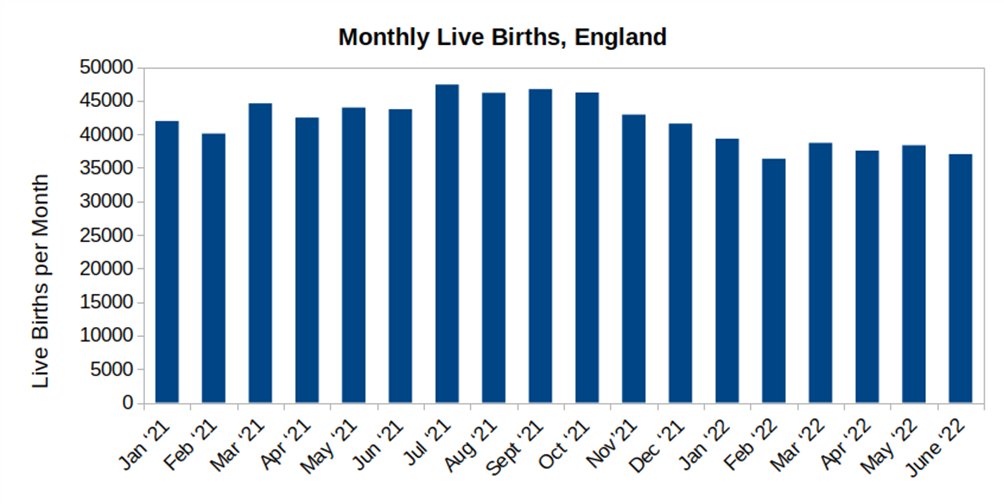
It is worth pointing out an aspect of these data even though it is ‘obvious’ – women are pregnant for nine months before they give birth, so whatever it is that might have caused this decrease can probably be traced back to spring 2021. Also, we’re now at the point where most new parents will already have been vaccinated at the point of conception of their baby, thus as the birth rate doesn’t appear to be returning to its pre-2022 level it is becoming more likely that if the vaccines are responsible for the reduction in birthrate that it will be an ongoing problem (compared with a transient problem if the vaccines only impacted on birth rates when given during pregnancy).
Other online commentators have suggested that this apparent fall in fertility rates is only because the UKHSA births data are preliminary, however, successive Vaccine Surveillance Reports haven’t seen updates in the births data of the necessary magnitude (e.g. the births figure for August 2021 was 47,157 when it was first published and was 46,149 in the latest update – a fall of close to 1,000 births). Note that while I discussed ‘missing data’ in the previous paragraph, these missing data are for 2021 and the issue with lower birth rates appears in 2022. For the other nations of the U.K., preliminary births data from Scotland also appear to show a reduction in births by around 10% in recent months compared with the 2017-2019 average, while data for Northern Ireland and Wales for 2022 don’t appear to have been made available yet.
It is important to state that there is no concrete evidence that the lower birth rates that are being observed around the world are due to impairment in fertility or increases in miscarriage and stillbirth: it might simply be a behavioural effect associated with lockdown or vaccination. For example, the birth rate problem might be a consequence of forcing young loving couples to not have any break from their partner for months on end in 2020, leading some to reconsider their future plans. However, a similar reduction in birth rates has been seen in Sweden, which didn’t lock down to the same extent as other Western countries, as described in a recent blog post by el Gato Malo – data from the Swedish Statistic Bureau show this significant decline.
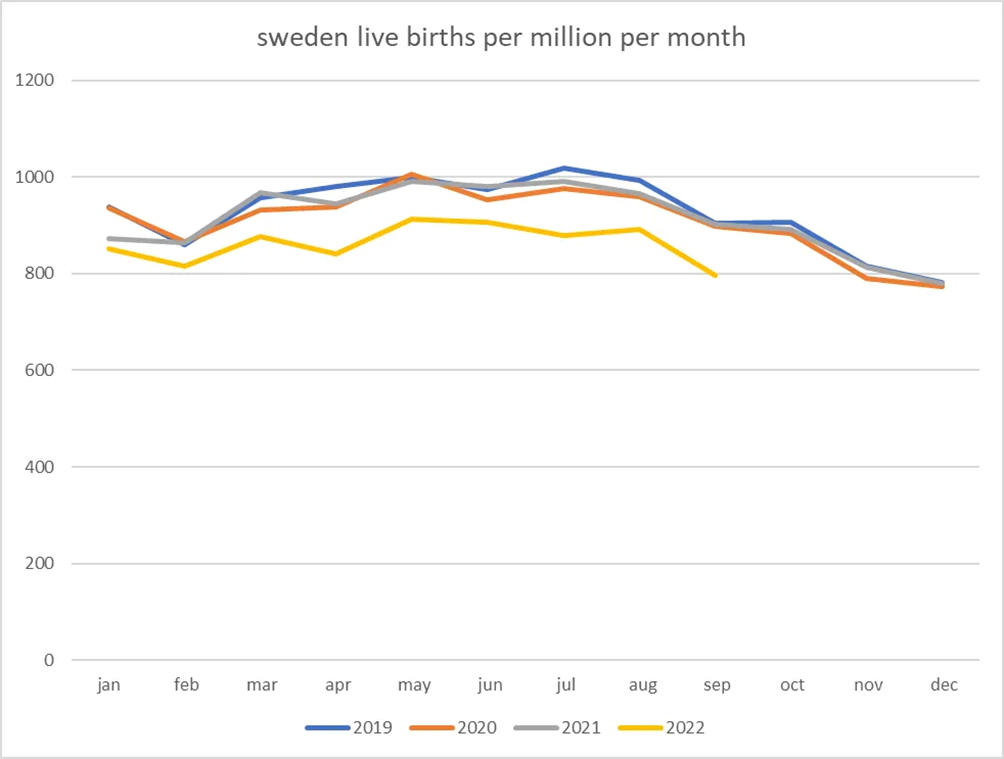
It is also important to note that the apparent reduction in birth rates could be due to the Covid vaccines or Covid itself – while the lack of any real reduction in birth rates after Covid arrived on our shores but prior to the start of mass vaccination suggests that it is more likely to be a vaccine effect, this isn’t conclusive. In addition, human fertility is complex; the reduction in birth rates could be due to diverse factors such as an increase in erectile dysfunction or a decrease in libido.
Whatever the causal factors, it would be reasonable to think that there would be robust investigations into this drop in birth rates, but there are no signs of these investigations even though the impact by vaccination status should be relatively simple to study, at least compared with other factors (though underlying differences between vaccinated and unvaccinated cohorts would need to be accounted for).
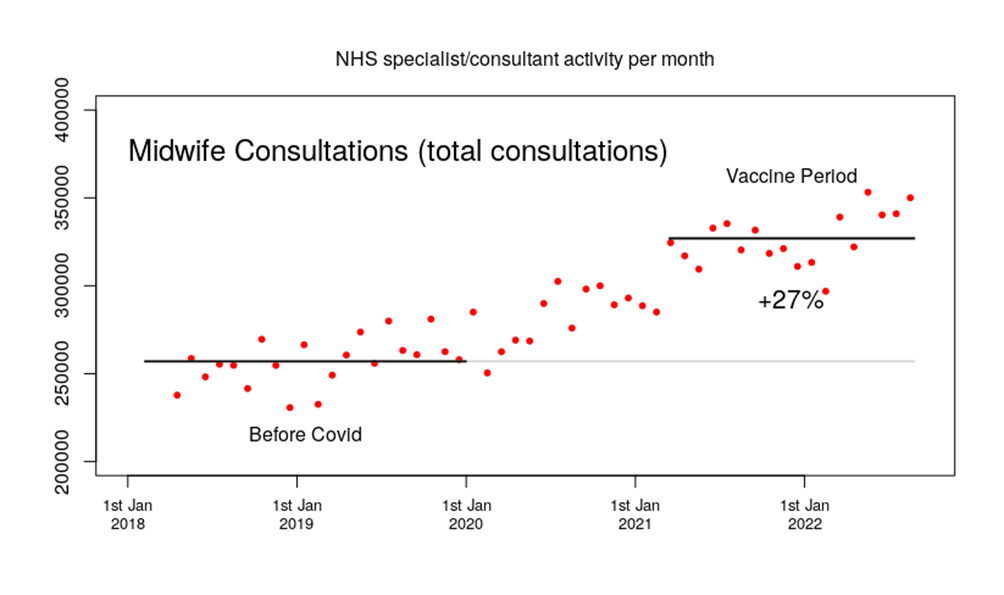
Another strange aspect of the recent births data for England is that they appear to run counter to data from hospital consultant activity over the same period. For example, midwives have seen increased activity even as birth rates dropped.
Even stranger, the same data source shows an increased workload for hospital consultants specialising in the newborn baby.
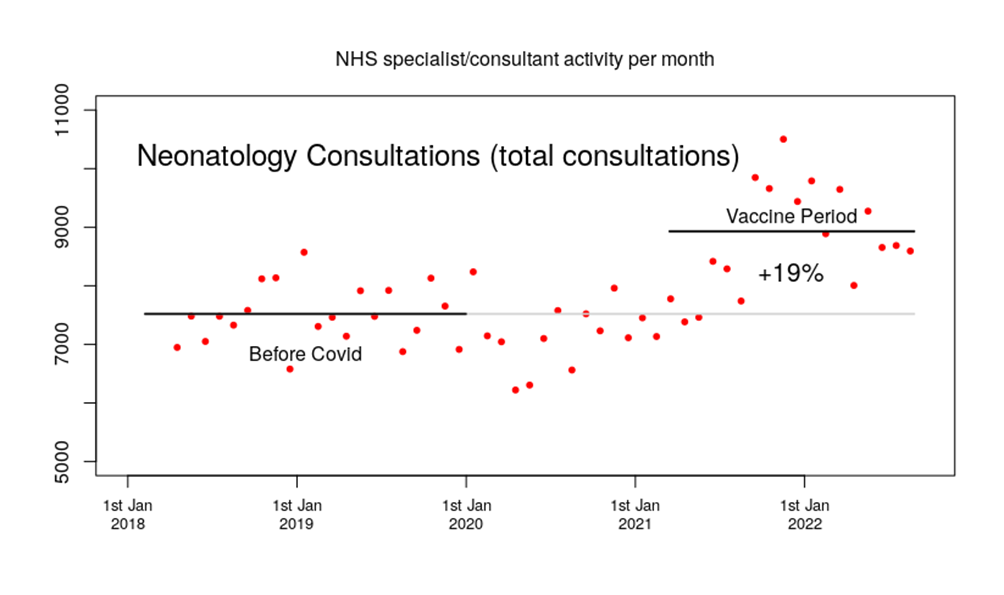
It isn’t clear why the midwife data shows their workload to have increased despite fewer babies being born. It also isn’t clear why there’s more activity by specialists in the health of the newborn, or whether this reflects higher levels of medical problems in full-term babies or an increase in pre-term babies (that said, data in the UKHSA Vaccine Surveillance Report suggest that there’s been no significant change in the proportion of babies being born pre-term).
Another important aspect that has been ignored by the Vaccine Surveillance Report is the protection offered by the immune system after natural infection. Vaccination, of course, offers the immune system ‘a taste’ of the infection without all the risks of actually getting infected, resulting in some level of protective immunity. In general, vaccination is preferred to natural infection for many diseases (the serious ones) because vaccination gives protection without the risks incurred with infection. However, if the individual has had the infection anyway then the risks will already have been incurred – while vaccination could offer some additional protection for some diseases, this doesn’t appear to be the case with Covid. Given that the Omicron variant appears to have infected the vast majority of the population of the U.K. (certainly the majority of women of child bearing age), is there anything to be gained by cajoling the remaining minority of vaccine sceptics to take the jab? For some strange reason the UKHSA decided to not inform prospective mothers of this nuance and instead steamrollered ahead with its push for vaccination, even though questions remain about the risks of the vaccines on fertility, pregnancy and the newborn child.
One final point – in the Vaccine Surveillance Report’s section on the impact of the vaccines on pregnancy it presents data on the number of mothers who got vaccinated after their pregnancy had ended. I very much disapprove of this as it is not relevant to the question of whether vaccination affects foetal development and appears simply to be propaganda to encourage vaccination.
In my next and final post in this series I’ll discuss a part of the Vaccine Surveillance Report that caused quite a stir when it started to go against the Government’s narrative – the data on infections, hospitalisations and deaths by vaccination status.
Amanuensis is an ex-academic and senior Government scientist. He blogs at Bartram’s Folly – subscribe here.
To join in with the discussion please make a donation to The Daily Sceptic.
Profanity and abuse will be removed and may lead to a permanent ban.
Thanks for this. I haven’t seen any news that health authorities in Scotland have discovered the cause of the mysterious spike in stillbirths during September 21 following the Scottish Midwifery Council and Scottish chief medical officer encouraging pregnant women to get injected during August 2021. I suggest they probably won’t unless they investigate whether a disproportionate number of women who suffered this loss had been injected. The authorities have said that they won’t carry out this simple check because they know of no mechanism as to how the injections might be linked. Fortunately, Dr John Snow did not share that attitude when he used numbers to link an outbreak of cholera to a contaminated water supply without knowing the mechanism. They might also want to consult Robert Malone as to a potential mechanism. I saw a video of him warning about this a long time ago.
Not to mention Geert Vanden Bossche who was spot on from the start and then duly censored/muzzled like the rest of the world class experts questioning the non science aka nonsense.
Nice Biblical tie-in. May I suggest that the story of King Herod and the Massacre of the Innocents might be more apropros? In terms of finding a link between vaxx rollout and declining birth rates 9 months later, a comparison of countries could be of some use. Countries like the UK and Israel rolled out hard and fast, jabbing as many people in as short a time as possible. Here in NL the rollout was very methodical by age group over an extended period, starting end of January 2021 with HCW and people in care homes, then the oldest persons living at home, with people being ‘invited’ to get a jab by year. The age groups most likely to have children were probably jabbed between June/July and September 2021. In countries like the US it is worth looking at when work and university vaxx mandates were implemented. As for whether vaxxing during pregnancy seems to have turned out okay – as you point out, they can’t know that yet. I have a feeling there may be something very nasty in store in that respect that may take several years to become apparent. Five years before they pulled Thalidomide. And a… Read more »
Thanks for the NL perspective, always helps to get different points of geographical view.
Without shooting the dead horse too often, the answer to question the article poses must be yes. Infertility would be a key objective if you believe that the stabbination is part of depopulation. This includes still born dead and overall fertility rate reduction which is spiking around the world. This would also entail stabbinating young people to disrupt their natural reproduction systems. Those who don’t believe the above, will be inclined to look for other causes (which could include contaminants found in food, water, other drugs and normal stabs). In the end the poisons are going to have a huge affect on sterility imo.
Did someone say depopulation…
This video is good..
https://expose-news.com/2022/12/13/mike-yeadon-depopulation-agenda-is-real/
To the best of my knowledge Dr Mike Yeadon was the first significant man of science to raise the subject of depopulation. He has been on the money from early days.
Apologies I posted before reading your response but clearly we share the same view on the injections and their likely outcomes.
My gut feeling is that the babies of mothers who have been injected will develop significant health problems and ultimately will suffer a much reduced life expectancy. Deleterious health impacts will at some point in the future manifest in the children of injected mothers quite simply because those impacts were part of the recipe of the so-called “vaccines.” I would expect sterility to be an absolute certainty.
https://stevekirsch.substack.com/p/did-you-know-that-in-santa-clara
I had a look at the new UKHSA VSR December report linked to by Steve here.
On the surface and to laypeople, it makes the goo looks like magic.
I know you looked into its omission of looking into side effects and the fatal TNCC flaw before here, and that the 14 day period renders everything questionable anyway, but maybe this is a good time to also provide us with a summary of everything that’s wrong with these reports at the same time you discuss its claimed efficiencies or in a concluding piece?
When I read these sorts of analyses, which are great, I can’t help having the following train of thought.
Most people don’t want to hear this because it’s too challenging of their worldview.
If they are prepared to hear it they won’t believe it.
If they do believe it, they’ll try to attribute it to something “natutal”.
And if by sone miracle it could proven beyond doubt that we’ve artificially made a huge dent in our childbearing capabilities (I.e. many women and/or men have been sterelused), they’ll assert it’s not such a bad thing because there are too many people on the planet and climate change and blah, blah, blah.
I am convinced that the news that birth rates on the UK have taken a huge dip will be met with a resounding cheer.
Interesting. I would like to know whether the dip we are seeing is unusual when compared to long term trends. If it is not then other explanations are possible, though one would need to see if previous historic dips are reasonably consistent across countries, as this current one seems to be (at least in the countries mentioned in the article – ideally one would like to see the data for as many countries as possible).
Ideally we would have had proper research being undertaken as part of the vaccination programme. Our authorities can be excused for not doing this for the initial vaccine rollout for the most vulnerable, but for everyone else (under 65, children, pregnant, hoping to become pregnant, etc etc) these studies would have been relatively easy to undertake (and are what would have been done for any other medical product).
In your view, on the spectrum of hysterical to idiotic to evil, where do the main protagonists stand – asking as you may have more insight than I do, having met these people. I struggle to believe that anyone who gains and holds on to high office is capable of hysteria and they cannot possibly all be stupid. Whitty and Vallance are not daft.
I’ve just watched a heartbreaking video of NZ fascist police forcibly taking a baby from the parents home for surgery and which the parents have requested unvaccinated blood. The poor mother was distraught. How can they do this?
This is old news now. You’re talking about baby Will I presume? He’s had his surgery and doing well. That was the last I heard a few days back. Nobody can confirm if he got vaxxed blood or not in the end because the blood banks don’t distinguish or even bother to test which is which.
I’m inclined to defer to experts in this field such as Dr Thorp in the US and his recent paper and findings when he compared the Covid jabs to the flu jab. This is just one country so I would assume other high vaxxed countries are seeing similar troubling data regarding menstrual irregularities and pregnancy outcomes which would obviously influence their birth rates;
“Pregnancy and menstrual abnormalities are significantly more frequent following COVID-19 vaccinations than that of Influenza vaccinations. A worldwide moratorium on the use of COVID-19 vaccines in pregnancy is advised until randomized prospective trials document safety in pregnancy and long-term follow-up in offspring.”
https://www.preprints.org/manuscript/202209.0430/v1
Interestingly, births in the Netherlands seem to be increasing. So this is a direct contradiction to the above info/hypothesis because we are a high vaxxed ( well above 80% ) country. I’m no expert in statistics and I know data can easily be fudged but we can only work with what we can find. Is the NL an outlier or does it support the whole ”correlation does not prove causation” mantra we’re all familiar with by now? Why would Sweden’s data look so different to here, for instance?
https://www.macrotrends.net/countries/NLD/netherlands/birth-rate
I note that their collected data only goes up to 2021. Data for 2022 and onwards is modelled.
Ah OK. So it’d be interesting to get the real world data on birth rates from this year. But no significant drop in 2021 births though. 2022 would be more telling I think because more people would have been jabbed and potentially completed pregnancies by this year’s end.
That’s really interesting — thanks for linking it.
The second massive question to arise from this (no. 1 being is it the stab?) is whether or not the birth-rate drop is permanent? Or, put another way, has the stab (assuming that’s the culprit) actually sterilised say circa 7-8% of those of child-producing age who’ve succumbed to the propaganda?
Temporary suppression of fertility is one thing (bad enough though it is), but actual sterilisation is off-the scale horrific, a whole new level.
(I say 7-8% – that’s allowing for not everyone of child-producing age being stabbed and the fact that only one partner has to have fertility problems for there to be no conception.)
Why was there increased HCP activity at the same time as a drop in the birth rate? Making TikTok videos or attending EDI workshops??