
Could Minsk II Have Prevented the War in Ukraine?
Since Russia’s invasion of Ukraine began, Western commentators have spent a huge amount of time expressing moral outrage at Russia’s actions, but comparatively little time thinking about how the war could have been prevented.
This is puzzling. Even if Ukraine manages to win, this victory will have come at an enormous price – tens of thousands of lives, millions of refugees (many of whom may never return), and untold damage to the country’s infrastructure. No matter what the outcome, the war will have been disastrous for ordinary Ukrainians.
It therefore seems essential to ask whether it could have been prevented.
One possible way it could have been prevented is through deterrence. NATO members could have announced in advance, ‘We commit to defending Ukraine if it is ever attacked by Russia’. Alternatively, the U.S. and its allies could have armed Ukraine to the teeth by transferring huge quantities of offensive weapons.
The disadvantages of this approach are obvious. It might have caused Russia to invade even sooner to forestall the arrival of NATO troops or weapons. And if Russia did call the West’s bluff, it might have sparked World War III, as NATO would have pre-committed to entering the war on Ukraine’s side.
There’s another possible way the war could have been prevented: through the implementation of Minsk II. This was an agreement signed in 2015 by representatives from Russia, Ukraine and the two separatist republics, which aimed to bring an end to the fighting in Donbas. It was based on a plan drawn-up by the leaders of France and Germany.
Although Minsk II ultimately failed, since neither side honoured the terms, it was unanimously endorsed by the UN Security Council.
Critics of Minsk II say it was too favourable to the Russian/separatist side. This is because the agreement would have granted significant autonomy to the two Donbas regions, allowing them to veto Ukraine’s future membership of NATO and possibly its membership of the EU as well. (Minsk II is roughly equivalent to the plan John Mearsheimer put forward in 2014, which emphasised Ukrainian neutrality.)
For Ukrainians who aspire to fully integrate with the West, not being able to join NATO or the EU represents a major loss. Yet a significant minority of Ukrainians want to remain close to Russia, and for them fully integrating with the West represents a loss.
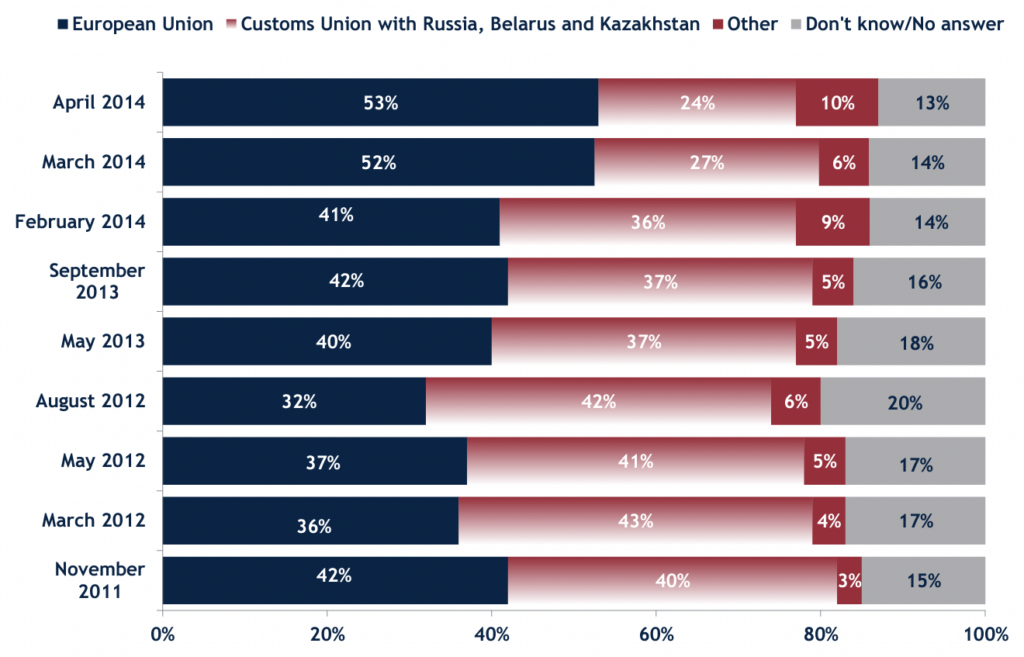
As late as February 2014, the percentage of Ukrainians who wanted to join the EU was only 5 points higher than the percentage who wanted to join the Eurasian Customs Union. The balance of opinion then shifted after the ‘Revolution of Dignity’.
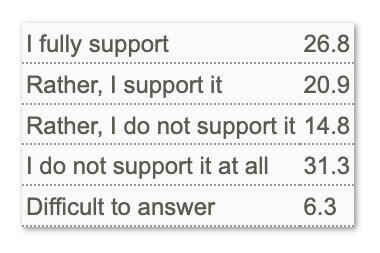
Likewise, almost half of Ukrainians opposed the Maidan protest movement, including a plurality who “[did] not support it all”. For this reason alone, calling the subsequent change of government a ‘Revolution of Dignity’ is highly dubious.
The fundamental problem for Ukraine was that a majority of citizens sought closer ties with the West, but a significant minority sought closer ties with Russia, and these two aspirations were mutually incompatible.
You might say that in a democracy, the majority gets to decide the future path of the country, so Minsk II was fundamentally unfair. Yet it’s widely understood that in ethnically divided countries, the majority often has to make concessions to the minority for the sake of overall stability. Half the parliamentary seats in Lebanon are reserved for Christians and half for Muslims, regardless of the ethnic make-up of the country (which no one quite knows), to prevent one group from dominating the other.
In any case, the European interest – as judged by the leaders of France and Germany – was preserving stability in Ukraine, rather than ensuring the country’s pro-Western majority got its way.
According to the New York Times, the plan for Minsk II emerged “in response to reports that lethal assistance was now on the table in Washington”. In other words, the U.S. wanted to start supplying Ukraine with offensive weapons, so France and Germany stepped in to broker a peace deal before that happened.
Why did Minsk II fail? As I’ve already stated, neither side upheld its end of the bargain. Yet historian Anatol Lieven argues it could have worked but for “the refusal of Ukrainian governments to implement the solution and the refusal of the United States to put pressure on them to do so”.
Lieven’s argument is consistent with numerous public statements made by Petro Poroshenko, the former Ukrainian President under whom Minsk II was signed.
In 2020, a Radio Svoboda journalist asked him whether he signed Minsk II in order to “buy time”. Poroshenko replied, “Of course”. He also said he was “categorically against” granting “special status” to the Donbas because it would lead to the “federalization of Ukraine”.
In June of this year, he told a different Radio Svoboda journalist, “We achieved what we wanted … our task was, first, to avert the threat, or at least to postpone the war – to secure eight years to restore economic growth and create powerful armed forces” (skip to 00:20:20).
He said the same thing on German TV: “What is the results of the Minsk agreement?” Poroshenko asked. “We win eight years to create army. We win eight years to restore economy. We win eight years to continue the reforms and to move to the European Union” (skip to: 00:07:20).
And just last week, he fell victim to two Russian pranksters (the same ones who pranked George Bush) and admitted, “I need this Minsk agreement for having at least four and a half years to build Ukrainian armed forces … to train Ukrainian armed forces together with NATO, to create the best armed forces in the Eastern Europe, which was built on the NATO standard” (skip to 00:05:00).
All this suggests that, even if the Russian/separatist side had taken the initiative in upholding their end of the bargain, Poroshenko never intended to implement Minsk II.
His stance was echoed by Ukraine’s Foreign Minister Dmytro Kuleba in February of this year. Mere weeks before Russian tanks rolled across the border, he told a Polish newspaper, “None of Ukraine’s regions will have a right to veto the state’s decisions. That is engraved in stone!”
But why, as the country’s main backer, did the U.S. not pressure Ukraine to implement the agreement? After all, the U.S. endorsed the agreement in its capacity as a member of the UN Security Council, and the U.S. pressures its allies to do things all the time.
The obvious reason is that U.S. interests were not served by the implementation of Minsk II.
From a Western perspective, preventing the war in Ukraine would have required the French and Germans to act more decisively, or the Americans to look beyond their own interests. Unfortunately, neither of these eventualities came to pass.
To join in with the discussion please make a donation to The Daily Sceptic.
Profanity and abuse will be removed and may lead to a permanent ban.
Not sure how the West through Minsk II pushing Ukraine to trade over the Donbas supports the narrative that The West has been pushing Ukraine into this war against the will of the people.
“This is puzzling. Even if Ukraine manages to win, this victory will have come at an enormous price – tens of thousands of lives, millions of refugees (many of whom may never return), and untold damage to the country’s infrastructure. No matter what the outcome, the war will have been disastrous for ordinary Ukrainians.”
Of course fighting comes at a high price. Same for Britain in WW2. Together with the recent survey of Ukranian attitudes, perhaps finally Noah now accepts this war is due to Ukraine’s will for self determination and with that “a given,” the simple fact is they were attacked by Russia leaving them no choice but to fight. It is not, as many on here seem to think, a dastardly propaganda plot by the West to twist the narrative and artificially generate support for war against the will of the Ukrainian people.
If by “self-determination” you mean Ukraine’s right to join NATO regardless of Russia’s wishes / concerns, I think that is not realistic – I refer you to Cuba’s 1962 decision to host nuclear missiles supplied by the Soviet Union and the USA’s (I would argue) legitimate objection to that.
You seem to think tyrannical despotic regimes have principled rights beyond their ability to exercise Power or that nuclear weapons de-facto grant Russia the ability to exercise that power. It seems to me rather simple, in both cases, the Russians are learning, they do not.
‘tyrannical despotic regimes’ surely you mean Canada?
Yes! Though I would still rather think it is an individual fascist subverting Canada rather than something, as it were, in their political DNA.
As Mearsheimer debunked this ‘every country is free to chose its alliances’ BS: if you are a small country living next to a big one, you aren’t and can’t.
Of course Minsk II would have prevented the war if US/Europe had applied more pressure to neo nazi loving Ukrainian regime. Remember that the clown Zelensky was elected on the peace for Donbass mandate and when trying to implement it he was threatened with life by the far rights. And why is the federalization (and neutrality) which works for more civilized countries (i won’t bother giving examples) wouldn’t have suddenly worked for Ukraine? Even a leader of a far right organization at some point said on camera, that the federalization was most likely the only workable way forward for Ukraine given how divided the country had been. US/NATO minding their own business and living other countries alone minsk 2 agreement russian crimea, independence for LDPR, neutrality for Ukraine (demands shortly after invasion) russian crimea + 4 Ukrainian regions go Russia + half destroyed country (you are here) nuclear holocaust When MSM says Ukraine is very close to victory, I’m not sure I understand what they mean. After 8 years of US and NATO’s help with creating a modern army Russia enters with 150K troops and after 9 months they still there and occupy a sizable chunk of the country having… Read more »
The US, and UK, always WANTED this war.
And any other past, present and future one.
Yes.
Drive a permanent wedge between Europe, especially Germany, and Russia.
Just imagine, peaceful relations between hi tec. Europe and Russia with its basic, plentiful and cheap natural resources.
Tit tut, that would never do would it Uncle Sam, you purveyors of death, sorry, of democratisation to free the world. Lol.
What the Germans will do is the key…
Instead we are, it seems, to purchase vast and expensive quantities of LNG in ships from – guess who.
How very green as well.
Some good observations: https://thesaker.is/the-oun-russia-war-no-longer-an-smo-what-do-the-parties-want-and-what-does-the-future-hold/ “… The big question is this: why has Russia not yet destroyed 100% of Ukrainian infrastructure, which it could easily have done months ago? To US analysts, this was a puzzle, because standard practice of the USA has always been to completely destroy vital civilian infrastructure from day one, as in the case of Yugoslavia or Iraq or Libya. Possible explanations for Russian reticence are: Russia has far greater concern and respect for civilian lives than the USA has ever had, certainly much more so than the terrorist Ukronazis – who were deliberately bombing civilian areas in Donbass for the eight years prior. Complete interruption of electrical and water supplies in Ukraine will inevitably lead to the abandonment of all western Ukrainian cities and a massive exodus of at least 8 million Ukrainians to the countries West. This, along with the economic and energy hardships now afflicting Western Europe (as a result of their sanctions against Russia backfiring), will lead to massive social unrest, possibly even the collapse of some Western European countries. This horrific prospect is a massive bargaining chip that Russia holds over the West and is a huge incentive for the OUN to… Read more »
the truth will come out eventually. like with lockdowns and the ‘safe and effective’ vaxxes, you now see that people who were totally brainwashed by round the clock BBC propaganda now start asking questions and admit that maybe lockdowns did more harm than good and vaxxes might only be beneficial for the very old and sick and that the corrupt big pharma didn’t suddenly stop being corrupt during covid. One can see that more and more people in the west start asking questions about the war. Was it really ‘unprovoked’? What was going on in Ukraine prior to this year? Are there really no neo nazis just because Zel is a jew? what exactly do US bio labs do in Ukraine? What’s the POTUS son’s interests in Ukraine are? who shells nuclear station? who did really blow up the Nord stream pipelines? Are Russian soldiers really given Viagra to indiscriminately rape woman and children? Why didn’t Russians carpet bomb the hell out of the country before invasion like its usually done? Maybe Ukraine does endanger civilians by using them as a human shield? Isn’t Ukraine in breach of the human rights convention when torturing and killing POWs and ‘collaborators’? Was… Read more »
Good list.
I would not be so harsh on Toby though.
Yes, he is and likely wants to remain establishment- he is not willing or able to go as far as Delingpole in that regard.
I think it’s a hedge and survival strategy for him.
We must be and remain cognizant of what he did already sofar and that he still provides us, Noah&co a platform, even on that surely most difficult topic for him.
As his FSU engagement shows, I think first and foremost he is a free speech absolutist, and that is what really matters and is lacking elsewhere these days.
it just feels strange that in many areas where MSM leads us to believe that the debate is settled, be it covid, climate change, cancel culture, etc.etc, the DS is able to cut through BS or at least provide alternative opinions, but in all things Ukraine it’s in (almost) total agreement with the empire.
Asking if a war could have ben prevented after it’s already been going for 9 months seems to be as useful as asking how many angels can dance of the head of a pin.
There is so much wrong with this article. It ignore the long established pattern of Russian reaction when opposed by a significant adversary. When Turkey shot down a Russian jet on the Syrian-Turkish border & made it clear it would do so again if necessary, Russia did… nothing. So, Putin did not attack Ukraine because it wanted to join NATO (Germany made it clear it would veto that anyway), it attacked Ukraine because Russia has openly stated imperial ambitions and Ukraine wasn’t in NATO, which is an entirely different thing. Had NATO said “We will not deploy inside Ukraine unless Russia attacks it, at which point we will immediately move in & support Ukraine directly militarily”… this war would never happen for the same reason NATO has not intervened directly in Ukraine right now: neither side wants a shooting war between nuclear powers. But far from doing that, NATO made it clear that was not even a possibility. And so Russia attacked because the appeasers gave the impression the West would reply just as it did in 2014 with little more than official grimaces. Russia did not attack because it feared NATO strength, it attacked because NATO nations & the… Read more »