
Norwegian Social Scientists Prefer Left-Wing Conclusions
Academics in general, and social scientists in particular, are notoriously left-wing. But do their political views influence how they evaluate research? That’s the question addressed in a new study by Henning Finseraas and colleagues.
The researchers carried out a survey experiment on a sample of Norwegian social scientists – a group that leans heavily left. (According to a recent survey cited in the study, 82% support left-wing parties, compared to only 44% of the general population.)
Their study concerned the academic debate between “group threat theory” and “social contact theory”. The former claims that contact with immigrants makes natives more hostile to immigration, while the latter claims the opposite. Since group threat theory implies that immigration has certain negative consequences, it is less ideologically appealing to those on the left.
371 social scientists agreed to take part. They were randomly assigned to one of two conditions. All respondents read the passage of text below dealing with a fictious piece of research, except that the final sentence differed between the two conditions.
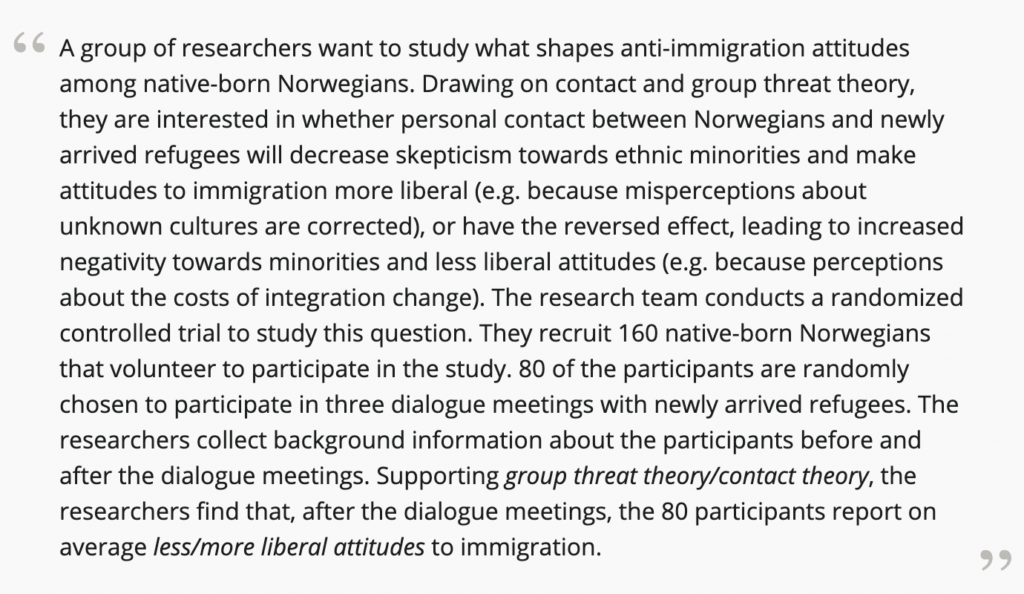
In the first condition, it read, “Supporting group threat theory, the researchers find that, after the dialogue meetings, the 80 participants report on average less liberal attitudes to immigration. In the second condition, it read, “Supporting social contact theory, the researchers find that, after the dialogue meetings, the 80 participants report on average more liberal attitudes to immigration”.
In other words, half the respondents were told that the research supported group threat theory, and the other half were told that it supported social contact theory.
After reading the passage of text, respondents were asked to rate the research on 0–10 scale for quality and importance. What did Finseraas and colleagues find?
Respondents in the second condition rated the research as significantly higher quality and significantly more important – even though the subject and methods of the research were identical in both cases.
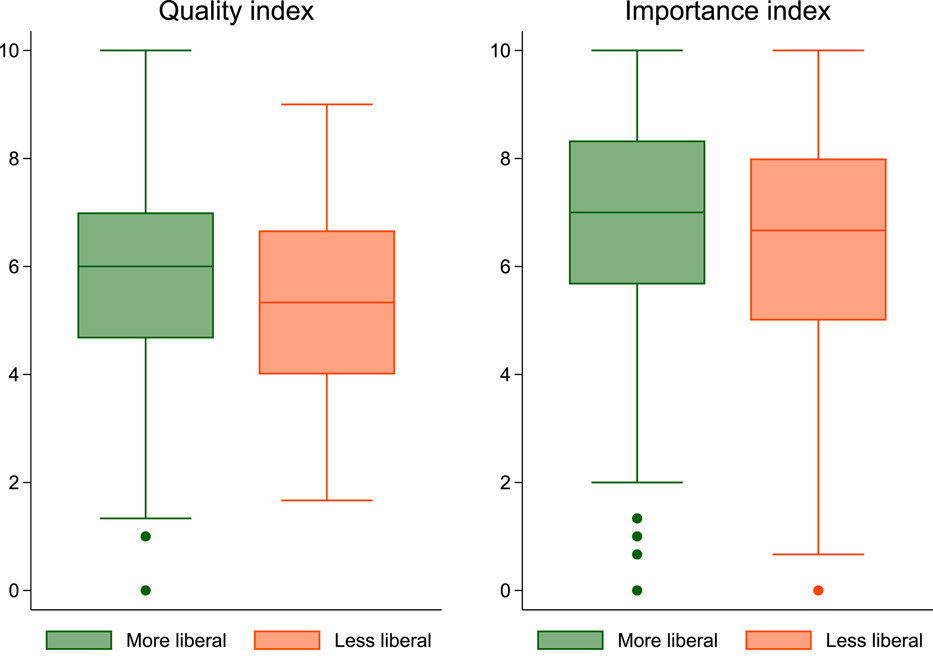
The differences between the two conditions were equal to 24% of a standard deviation for for quality and 22% for importance. These effect sizes would generally be considered small, though they were statistically significant.
Finseraas and colleagues’ findings demonstrate that left-wing social scientists evaluate research more favourably when the conclusions are ideologically appealing. This, of course, has major implications for peer review. It means that research running counter to left-wing narratives will be treated more harshly, and will therefore be less likely to get published.
I recently covered wrote ‘status bias’ in peer review; file this under ‘ideological bias’.
To join in with the discussion please make a donation to The Daily Sceptic.
Profanity and abuse will be removed and may lead to a permanent ban.
‘But do their political views influence how they evaluate research? ‘
Good grief! How could you even consider such a thing. I’m shocked.
The Science™️ – decide on the answer you want to promote your ideology/claims/lies then construct ‘research’ to prove it – computer modelling and algorithms are indispensable for this.
Nobody with a functioning brain who has been paying attention over the last few decades needs research to know this – it’s a given.
A delightfully succinct summary JXB👍
This is not just left vs right. Any established view is protected in peer review unless evidence is overwhelming. See the climate debate or the Covid debate.
Peer review, as described by Richard Horton, editor-in-chief of The Lancet:
“Peer review to the public is portrayed as a quasi-sacred process that helps to make science our most objective truth teller, but we know that the system of peer review is biased, unjust, unaccountable, incomplete, easily fixed, often insulting, usually ignorant, occasionally foolish, and frequently wrong”
“Social Scientist” is just like “Climate Scientist” – an oxymoron