
How Taxpayers Lose £24,000 a Year When Someone Switches to an Electric Car
Why is the Government using taxpayers’ money to subsidise relatively well-off company car drivers more than £2,000 a month to slum it in £70,000 electric cars?
I don’t want to come across as some po-faced champion of the people. I drove a company car for years, exploiting every tax loophole known to man and I confess I’d no doubt be at the front of the queue to grab an EV tomorrow if anyone was foolish enough to employ me and throw in an EV as part of my salary package. In truth, I feel a bit like a member of the Magic Circle about to betray the secret of exactly where the rabbit is hidden before it’s pulled from the hat. Except, in this case I’m going to explain just how much the rest of us are spending on cross subsidies to allow company car driving executives to burnish their personal green credentials as they swan around in £70,000 EVs.
Let’s suppose I was employed and that my current company car was a £70,000 diesel powered BMW and on October 1st I switched it for a £70,000 BMW EV. Company car tax rates are complex and vary from car to car, but typically I might expect to have been paying £9,800 in tax per year on the diesel BMW. By switching to the EV my tax bill would go down to £560. I’d be better off by £9,240 and HMRC’s tax take would be down by £9,240, which the rest of you would need to make up.
I know lots of people who have an EV. I don’t know any who don’t like them; no one I’ve come across would swap back to an internal combustion engine car. Why are we subsidising them?
But the subsidies don’t stop there.
Let’s assume the £70,000 diesel BMW achieves 40mpg and that it covers 18,000 miles per year. Let’s also assume that diesel costs £1.85 per litre. Over the year I’d spend £3,785 on diesel of which £1,083 would be excise duty and £631 would be VAT. Add them together and we get a total of £1,714 collected in tax.
Adding the company car tax of £9,800 to the fuel tax of £1,714 we get an £11,514 contribution to the exchequer. Divide that by the 18,000 miles driven and we can see that the diesel BMW was contributing 64p per mile driven to the country’s tax take.
Of course, the exchequer still needs that £11,514 contribution. If the car driver stops coughing up it simply falls to other taxpayers to make good the shortfall. The taxpayer goes from having a positive contribution of £11,514 to losing that and yet still having to dig deeper into his or her pockets to replace it; the difference between the two situations is £23,028. But as I’m about to take delivery of my new, stunning looking EV maybe the tax I’ll contribute for the benefit of driving that beauty will go some way to reducing that difference?
Let’s look at the picture after October 1st when my new £70,000 EV turns up. I’ll still drive 18,000 miles per year but this time those miles will be powered at the rate of about 4 miles per kWh, that’s a total of 4,500 kWhs.
I wrote a piece in the Daily Sceptic in August about the relative cost of driving an EV in comparison to an internal combustion car. It assumed that the price per kWh of electricity would go up to 52p on October 1st 2022. That it would increase to 79p on January 1st 2023 and would further increase to 97p on April 1st 2023. We now know that this isn’t going to happen – though the Government’s actions haven’t cancelled the market forces driving up costs but simply deferred the costs by introducing a tax-funded subsidy. At the time of writing I haven’t yet seen what the ‘energy price guarantee’ will be in terms of the price per kWh but it looks like it’s going to be about the same as the current ‘energy price cap’ of 28p per kWh. This means that the taxpayer is subsidising each kWh at the following rates:

Let’s keep the maths simple and suppose that on average over the next 12 months the subsidy on the kWhs I charge the car with are at the January 1st 2023 rate, attracting a subsidy of 51p courtesy of the generous taxpayer. This means that I can expect that my electricity bill for the 4,500 kWhs I require to drive 18,000 miles will be subsidised by the rest of you to the tune of £2,295, or, if you prefer, by 12.75p per mile. If we look at the likely level of subsidy after next April, it will rise to 17.25p per mile.
Hang on, I can hear someone complaining at the back that I’m ignoring the tax I’ll pay on the electricity I charge the car with. You’re right, let’s add that to the mix. That’s 5% VAT, so on my 4,500 kWhs I’ll pay £63 of tax, or if you prefer, 0.35p per mile.
Let’s summarise. Driving my diesel 18,000 miles over the year I’d pay £11,514 in tax, working out at 64p per mile.
Driving my new EV I’d pay £560 in company car tax and £63 in VAT on the electricity, a total of £623 in tax or 3.4p per mile. But the taxpayer would, in addition, subsidise my kWh by £2,295. Let’s add those together: £623 – £2,295 = -£1,672, or looking at it another way, for each mile I drive the taxpayer contributes 9.3p.
Now let’s just look at the difference between me switching from my diesel to an EV. The taxpayer loses my prior contribution of £11,514, which the taxpayer has to make up, so that’s £23,028 in the swing going from a positive £11,514 to a negative £11,514 per year. In addition, the EV costs the taxpayer an additional £1,672; this gives us a staggering difference of £23,028 + £1,672 = £24,700. This converts into £1.37 per mile. That’s right, the loss to the taxpayer is £1.37 for every mile I drive my EV in comparison to every mile I would have driven my diesel.
In 2021, 190,727 electric vehicles were sold, accounting for some 11.6% of all new cars. More EVs were registered last year than over the previous five years combined. The Society of Motor Manufacturers and Traders (SMMT) commenting on the figures said: “Two-thirds of all new electric cars bought in the U.K. are purchased by businesses, rather than private buyers. The growth in the electric car market is being driven by the corporate sector.” No great surprise there on these figures.
I wouldn’t mind so much if it wasn’t for the self-righteous virtue-signalling that goes along with EV ownership. Just about everyone I know who drives some huge EV thinks they’re saving the planet, but surely, if it was planet saving they were primarily interested in, they’d have kept their old car going for another 100,000 miles or they’d have downsized to a basic car doing 80mpg. The figures I’ve seen claim an EV creates only 60% of the carbon footprint of an equivalent petrol or diesel car (though some analysts have suggested EVs actually emit more CO2 over their lifetime), but why compare to the equivalent car? If a diesel or petrol car achieved 80mpg or 90mpg, wouldn’t that be no worse for the environment than a 2.5 tonne all electric Land Rover? What’s more, it could be produced at a fraction of the cost.
Presently, the main people who can afford an EV are the relatively wealthy or the company car driver. The upfront cost of a new EV puts them out of reach of most people. But once these relatively wealthy people get hold of one it’s the rest of us who pay for it. The figures above look at the extreme case of the company car driver, but even the private buyer for whom there’s no company car tax benefit would see a huge saving. Let’s take for example a person driving a 12 year-old diesel doing 10,000 miles per year in a car doing 40mpg. He’d buy 1,137 litres of diesel costing him £2,103 at £1.85 per litre. This would contribute £602 in excise duty and £350 in VAT, a total of £952 in tax. Do the same mileage in an EV achieving 4 miles per kWh and the 2,500kWh used will raise £35 in VAT – but that electricity is subsidised by 51p × 2,500kWh = £1,275. Subtract £35 from £1,275 and we get a net cost to the taxpayer of £1,240 or 12.4p per mile. Again, looking at the difference, HMRC goes from receiving £952 to shelling out £1,240, a difference of £2,192 which has to be made up by the rest of us.
The table below looks at the difference in the tax for the fuel/kWh costs of EVs and cars with internal combustion engines. In each case the difference is the amount the taxpayer has to find to restore the tax take whenever a conventional car is replaced by an EV. I’ve ignored various other subsidies for EVs such as car tax to keep it relatively simple, but feel free to add your own list.
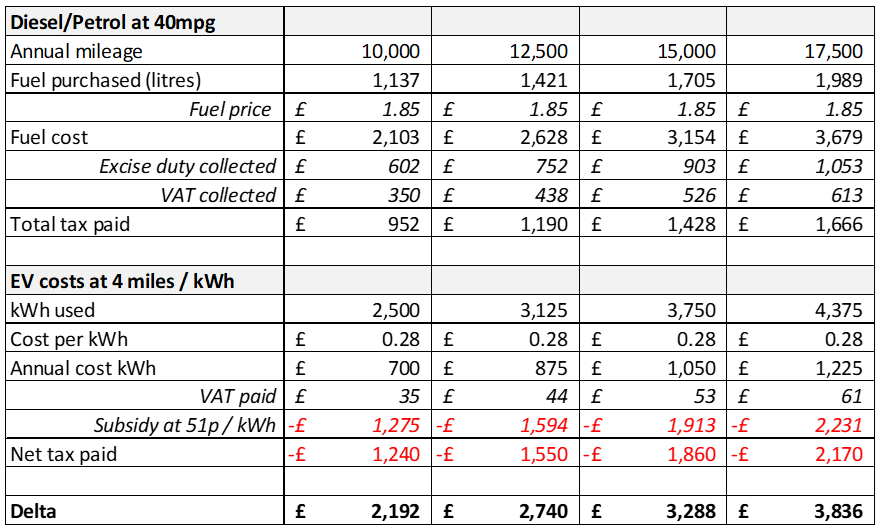
Virtue-signalling comes at a cost, but it’s a cost those of us who are being signalled at pay rather than the person doing the signalling. Shades of Marie Antoinette? How long before the driver of the 12 year-old diesel starts feeling resentful of the tax he’s paying to keep the £70,000 EV on the road?
Maybe we should look at lifetime environmental costs of all vehicles. If a sub 1 tonne, 90mpg diesel has a lower lifetime carbon footprint than a 2.5 tonne EV, why is the driver subsidising the EV?
Clearly, the taxpayer has pump-primed the market. Isn’t it time we throttled back a bit?
To join in with the discussion please make a donation to The Daily Sceptic.
Profanity and abuse will be removed and may lead to a permanent ban.
Don’t get in to co2 being bad, it’s plant food, when assessing the merits of EV vs petrol/diesel cars. We should get back to judging products like cars based on their cost, efficiency and performance, not on some idiot theory that demonises earth’s most crucial life giving molecule.
How on earth we got to a place where excessive consumption (in a town not near you) is somehow good for the planet and reducing consumption? Something tells me the governmental push for so-called “environmental EVs” is another prime candidate for dieselgate 2.0 in a scandal once to be revealed once all the dirt has been expelled in the wash. This is so absurd, more so that we’re falling for it. As far as CO2.. as I understand it, it makes up what.. 0.04% of our atmosphere? With our “contribution” in burning fossil fuels increasing that CO2’s ppm by ~3% I believe, that makes an additional 0.0012 of which once we’ve supposedly eliminated it will have a noticeable impact we could even detect, let alone observe? It’s the perfect grift isn’t it – like all these other invisible threats, can’t be proven either way. Much like vaccines in my opinion. Who’s to say it was the vaccine that cured you or your immune system. “Yeah, but studies?” Oh.. pshaw! Models, especially computer models can prove or disprove anything you want. Call me a sceptic but I’ve lost all faith. With the climate models we’ve all heard of ‘garbage in –… Read more »
I think you are roughly right on the average figures. Local variations can be problematic with many things, in particular the “dieselgate” issue was more to do with NOx emissions in urban areas, notwithstanding the fact that diesel engines are generally more efficient than the alternative.
On the other side of the coin, there were reports that some greenhouse firms deliberately increase the CO2 level inside to encourage growth, simply by using some exhaust from gas fired heating. Good value for money, from their perspective.
Note: wealth is measured by what we have, what we consume. Consuming more = wealthier, consuming less = poorer.
Don’t we say things like, look at that person/people, they don’t ‘have’ much do they?
We run economies to serve our wishes and desires not merely to provide our needs – animals do that and don’t have economies.
So. How on earth we got to a place where making our selves poorer is desirable?
Environmental issues for manufacturing and the whole service life of a product are more important than focusing on one item. Like how and where batteries are made, e.g.
We shouldn’t grace it with the word theory, it’s a claim supported by no evidence.
I am in this position now, in addition to the car lease they are throwing in insurance, road tax, all service cost and 5k per annum towards the charging cost.
I still don’t want one, due to the lack of range and charging faff.
I don’t think the maths is right. Because an EV driver gains £11500, and the taxpayer loses £11500, you can’t say the overall loss to the taxpayer is £23000. You are adding both sides of the ledger together while in reality one is a reflection of the other.
And your sums do not include the absence of road tax revenue for the EVs, notwithstanding the fact that they are relatively heavy vehicles that will cause more wear and tear.
A real sceptic might observe that they will soon find a way of ramping up VAT for home charging (they already charge 20% for the fast charging output at various places), and maybe even extra duty as well to cross balance the loss of fuel excise duty. Requirements to use “smart” meters in charging kit open the door to that. Or maybe one would have to shell out tax lump sums per distance run when it goes in for an MOT. They won’t like the loss of revenue for road fuel.
There is definitely going to be a bait and switch.
When they’ve forced EVs on everyone and outlawed petrol, the cost of charging the EV will skyrocket and will be more than petrol even at its worst.
Then they’ll tell us it was all really to save the planet and because nobody will want to feel like they’ve been conned, we’ll nod and say we only did it for the environment and not for the cost efficiency.
Pointing out that petrol was cheaper will be censored “misinformation”.
”When they’ve forced EVs on everyone’
In my view that is never going to happen, there are currently over 30 million petrol/diesel cars on UK roads, when I do the maths and consider all the technical, environmental, financial and political factors, I think the UK will be unable to have any more than 3 possible 5 million EVs. If they push ahead with this EV only policy, then ownership of EVs will be confined to the toffs and the elites, the best to which most of us will be able to aspire is the occasional use of an EV via the local community EV car group.
In my view EVs are not going to happen for the majority of the current ordinary low/middle income drivers.
2 million cars are sold every year in the UK.
At that rate it takes 15 years to renew all 30 million existing cars.
What’s the year all cars need to be “zero emissions” (i.e. electric)? 2035?
Looks to me like it’s pretty carefully thought out.
Given current technology, availability of raw materials, finance, battery re-cycling problems, and the limited charging possibilities, the UK cannot sustain 30 million EV’s. The advent of EV’s means the end of low cost road freedom for the hoi-polloi. Even if we could manage to produce and have 30 million EV car batteries in the UK the current battery recycling technology could not cope with the re-cycling required.
Maybe new technology will come along and make this all more possible? but usually you have the technical advance and then society changes to use the new technology.
With EV’s we are betting the farm on a system that we cannot sustain with current technology with only a feint hope that some magic new technology will come along. As it stands at the moment the UK’s EV policy will see many low and middle income motorists forced out of their cars and onto community and public transport schemes
Don’t worry. The national deb stands somewhere in excess of £2.5 trillion. That’s basically £2.5 trillion we”ve given ourselves that we dont have.
We have spent all the national treasure and raided our kids’ treasure chest and our kids’ kids’ treasure chest.
Pointing out the madness of EV subsidies is like drawing attention to a leaky tap in a house with a giant gaping hole in the roof during torrential rain.
We’ve not spent it, the establishment have spent our money on projects that we didn’t want but which enriched their mates, families & themselves.
Yes we have. A health service we can’t afford, pensions we can’t afford, furlough to encourage people not to work. Income support…etc etc
Decisions taken by folk on our behalf. Who wanted track & trace? PCR tests? 10 years of mRNA bioweapon injections? Partnership with WEF?
We didn’t choose to spend our money with the globalists, the government & uncivil service did, on our behalf.
To me is seems very much like the public demand an NHS, pensions, etc. They assume it’s all perfectly affordable and the only reason we have debt is mismanagement. They don’t accept that the stuff is fundamentally unaffordable. And you can see it by the reaction to austerity and cut backs.
As far as all the furlough goes, which has been totally ruinous, I haven’t seen too many complaints. My impression is that much of our population has been very taken by the idea of getting paid and not working.
What do we say to people who can’t see the real picture?
My colleagues Mini Countryman was (due to battery) heavier than my 2.0 SUV. Also factor in range anxiety for heart problems in later life. I fill up in 3 minutes for a range of 500 miles of stress free driving. What’s not to like? EV = Betamax.
My thoughts exactly. The 2.0 diesel BMW I used to have could do 700+ miles on a full tank, my current 2.0 petrol Merc 600+. When I can drive from the South of England to the North of Scotland in winter without refuelling in an ICE car and take just five minutes to fill the tank when I get there, why would I want an EV which would need 3 or 4 lengthy recharges along the way? Madness.
And it’s all based on a pernicious false assumption that human-generated CO2 which, by the way, is dwarfed by naturally generated CO2 is bad for the planet and it’s climate when the opposite is true. That’s what I object to.
Hydrogen. Most cars engines can be modified to run on hydrogen gas, JCB are building a hydrogen powered digger as they need to run 24hrs a day on large sites which isn’t possible with electric battery technology.
Not to be confused with hydrogen fuel cell which I believe is a dead end to keep hydrogen as a fuel back. Only exhaust is water and the power per litre is comparable to petrol.
Just need to produce some clean electric to make the hydrogen….. how about clean coal dug up from the UK?
If we can burn soot from Diesel cars and make them clean then why not coal?
Also Nicola Tesla anyone and free energy?
” I know lots of people who have an EV. I don’t know any who don’t like them; no one I’ve come across would swap back to an internal combustion engine car. ”
I wonder where you, and they, live. Down here in rural Dorset they’re pretty rare. That’s possibly because the public charging infrastructure simply isn’t available. And well over half the houses don’t have a private parking facility. In the small old market towns, cars are parked along the streets and you cannot assume you will park outside your own house.
EVs may be perfectly viable in a city environment. But they are inconvenient for long journeys, where more than one charge might be needed and in areas where finding a local charging point is problematic.
As a female driver – who drives long distances – I don’t intend getting one for the simple reason that I don’t trust the charge. With the radio, wipers, heating on they do far fewer miles to the charge than they claim and I really don’t want to get stuck out in the sticks with no power.
‘I know lots of people who have an EV. I don’t know any who don’t like them; no one I’ve come across would swap back to an internal combustion engine car. ‘
Lots? Define ‘lots’.
And what sort of people are they? ‘Lots’ of money, or company car owners, short journeys, driveway or garage where they can charge their car overnight? Another ICE car for real journeys?
I just ask.
And in due course that £24K lost tax revenue will find its way on to Road Fund Tax and tax on electricity to charge cars.
Those smug EV owners won’t be so smug then.
And then there will be the £10K to replace the batteries in due course… and in time there will be an environmental problem with all those dirty batteries needing disposal.