
The Ideological Capture of the British Media
Earlier today, Noah Carl wrote about Spain’s Great Awokening, citing the work of David Rozado who looks at the increasing frequency with which particular words and phrases appear in the mainstream media, such as ‘transphobia’ and ‘white supremacy’, indicating an embrace of woke ideology. The same researcher has now collaborated with the political scientist Matthew Goodwin to look at the British media. Unsurprisingly, the results show it has succumbed to the same intellectual virus. Here is an extract from Matthew’s Substack newsletter outlining their findings.
Over the last 20 years, between 2000 and 2020, the British media has been utterly transformed. Just like America, our media has become utterly consumed by identity politics, discrimination, and is increasingly embracing social justice ideology.
The Great Awokening, in short, is now just as visible, if not more so, here in Britain.
As you can see below, over the last twenty years media references to words such as racism, racist, white supremacy, and xenophobia increased, on average, by 511%, while words such as sexism, misogyny, patriarchy, and gender discrimination rocketed by 172%. So too have terms such as transphobic and transphobia (up 4143%), Islamophobia and Islamophobic (up 306%), and anti-semitism (up 381%).
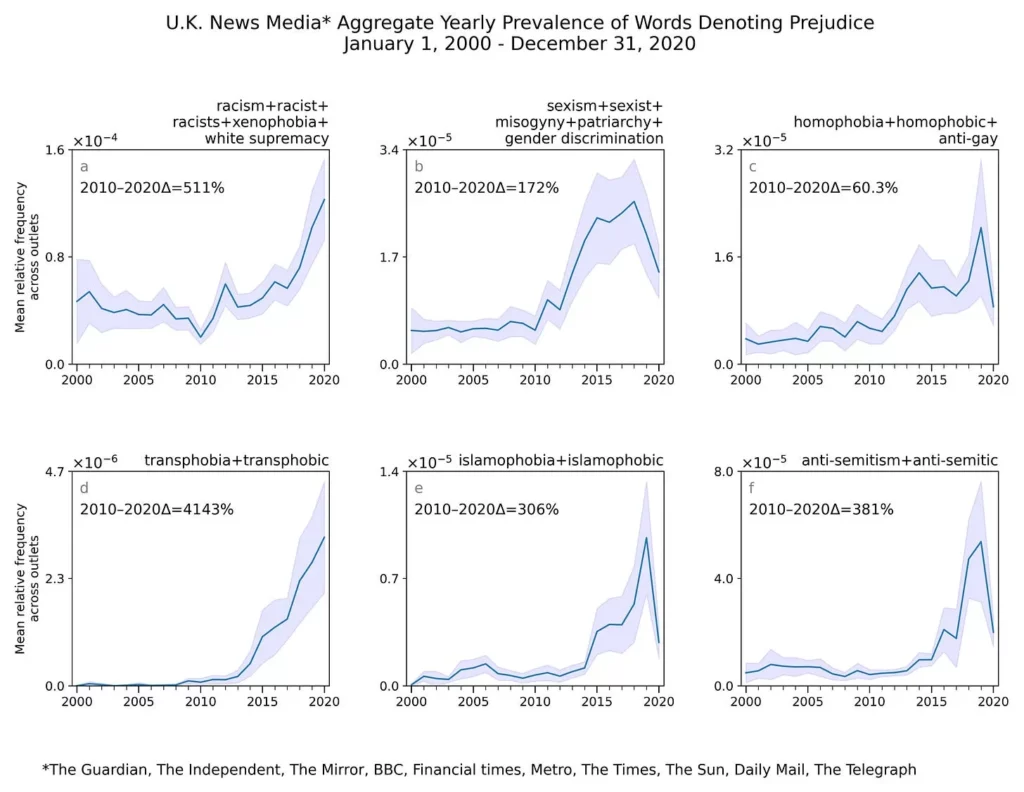
These sharp increases are pervasive across media – regardless of whether they are on the left, the right, or the centre (though they are most pronounced in left media, such as The Independent and The Guardian). The one exception, between 2015 and 2020, is references to anti-Semitism, which were more prominent in right-leaning news outlets – most likely in response to Jeremy Corbyn’s leadership of the Labour Party.
Mentions of prejudice have also become more prominent in the BBC, the leading public service outlet. From 2010 to 2020, BBC mentions of terms suggestive of racism increased by 802% while mentions of terms suggestive of sexism increased by 610%. Mentions of homophobia and transphobia increased by 134% and 3,341% respectively while islamophobia and anti-Semitism increased by 585% and 2,431%, respectively.
Similarly, references to words or concepts that are associated with social justice or woke ideology – such as social justice, unconscious bias, white privilege, whiteness, slavery, cultural appropriation, gender pronouns, and hate speech- have also surged.
Contrary to the argument that these are simply being pushed by right-wing culture warriors we actually find the opposite – they are being mentioned across both the right and left media, and are more likely to be cited on the left than the right.
They are reflected in stories about white schoolchildren in Brighton being told by teachers they are not ‘racially innocent’, the BBC flagging ‘Non-Binary Day’, or the Guardian complaining about the ‘whiteness’ of the England women’s football squad. The language of social justice is no longer just reflected in politics, universities, or celebrity culture; it is now widespread in the media people are consuming.
Worth reading in full – and you can subscribe to Professor Goodwin’s Substack newsletter here.
To join in with the discussion please make a donation to The Daily Sceptic.
Profanity and abuse will be removed and may lead to a permanent ban.
Indeed how things have changed, and how quickly. Here’s an article from The Guardian from 2002 by Rod Liddle Mr Blair says that we should feel guilty about this. Sorry, but I don’t | Rod Liddle | The Guardian “Rod Liddle on why Africa must take responsibility for its own problems….And then there’s the local culture. I asked a Unicef man what he thought Africa would have been like had there been no evil, exploitative whitey empires; no colonisation. “Umm, possibly China,” he suggested. Yeah, right. Another Unicef man laughed at the China suggestion. “You need to look at the lack of a work ethic, at the way in which the concept of time as a linear, constraining thing, is totally absent…” and a whole host of other sociological concepts which are missing from the core of African societies.” At the time, Liddle was believe it or not editor of BBC Radio 4’s “Today” program. Don’t think The Guardian would publish anything like this now, nor would the BBC employ someone like Liddle in a senior position, and lastly anyone talking about how African societies lacked the concept of time as linear would be denounced as literally Hitler and sacked… Read more »
Can someone check the units. TRhe vertical axis seems to refer to ten to the minus [4, 5, 6]. These are ten times orders and negative so it makes a big difference to reading the charts.
Moderator here: Yes we will check them again, thanks for your comment
We have checked these units and scales with the original author, and they are correct. The very small % number is understandable in the context that this software is surveying every single word or phrase used in the media.
The real question is why did this happen? Is it just spoiled journos and a never-ending supply of liberal arts students who have nothing better to do than naval-gaze and jump on the bandwagon du jour? What strikes me is that there is such a clear marker of when this really took off, around 2010 – 2012. If someone had asked me when I thought it started, that’s exactly the time period I would have said, without having any charts to hand. I just don’t believe it’s organic, it has been so ubiquitous and simultaneous and prolonged that it has to be organised. I used to read the Economist, around 2010 I started to find it increasingly annoying and around 2012 stopped reading it all together. I switched to the Dutch conservative weekly Elseviers, but knocked that on the head about 5 years ago, as it was clearly going the same way. Their best columnist left around that time, I have always wondered why. The self-censorship, the making an enormous fuss over ‘hurtful’ words while doing little about genuine crimes like burglary and assault, the strange need to persuade everyone to doubt themselves, to identify as something, particularly in terms… Read more »
Arguably started in 1968, or earlier in the 60s, or with the advent of communism, or with the French revolution…
From this Spiked article by Roslyn Fuller, a small part of which discusses the network of foundations funded by founder of eBay Pierre Omidyar: “Omidyar, whose Omidyar Network funds AELP, also funds the Democracy Fund which is now part of Omidyar Group (1). The Democracy Fund, in turn, together with the Knight Foundation, Quadrivium, the McArthur Foundation and Luminate (also funded by Omidyar) fund Democracy Works (2). Omidyar also funds Democracy Fund Voice, which in turn contributes to Defending Democracy Together (3). Then there is Healthy Democracy which is funded by the Democracy Fund, Silicon Valley Community Foundation (which also receives money from Democracy Fund) (4) and the Ford Family Foundation. The Omidyar Network also co-funds New Public by Civic Signals, along with the Knight Foundation, One Project, the National Conference on Citizenship and the University of Texas at Austin, Centre for Media Engagement. Of course, the University of Texas at Austin, Centre for Media Engagement is also funded by the Omidyar Network, the Democracy Fund (funded by Omidyar), the Knight Foundation, Robert McCormick Foundation, and Google. To name just a few others, the Ada Lovelace Institute also receives funding from Luminate, the Wellcome Trust and Nuffield Foundation, while TicTec, a MySociety event about ‘civic tech’, is funded by Facebook, Luminate… Read more »
I used to read the Economist, around … I started to find it increasingly annoying and around … stopped reading it all together.
Yes, me too. But substitute the dates 1991 and 1994. Anyone with a functioning brain starts to find The Economist annoying after about 2-3 years. Actual dates don’t matter.
I just don’t believe it’s organic, it has been so ubiquitous and simultaneous and prolonged that it has to be organised. That’s actually something which speaks against it being organised. Humans are infamous for f***ing up complicated schemes at pretty much every opportunity. Hence, something complicated which seems to work is very likely not organised because if it was, it wouldn’t. My guess would be that journalist recruiting is pretty uniform among relatively few, large organisations, basically all getting their new staff from the same, relatively small pool of students of certain soft science subjects which have long since cut off their original academic or art-based roots in favour of more or yet more woke musing about the politics du jour and how the subject matter of various background disciplines can be interpreted in line of that. Eg, I’ve started throwing (some) newly bought history books (history being a hobby horse of mine) away after reading them once on the grounds that they contain enormous amounts of unsystematicically presented Daily soap of 100 years ago details alongside political preaching and constantly writing about the Nazis regardless of what the supposed topic of the book was to be (English books about… Read more »
No, the media and wider institutional capture was organised. The media capture dates back to the 1950s. Ben Shapiro wrote a book on how it happened. The genius of the Frankfurt School was that they created a situation where people would absorb their ideas and follow them and spread them without actually realising they were using them.
I mean, my English GCSEs and A-Level were Critical Theory-based in the 1990s. So was Media Studies and Film Studies. Critical Theory is the Frankfurt School’s system of Marxist analysis. I suspect many teachers have no idea what they’re teaching and many pupils and students have no idea that they’re using a form of Marxist analysis instinctively in everyday life.
The Frankfurt School got into the US media in the 1950s, which is really where things took off. The push was away from programming that more conservative rural audiences would enjoy towards urban, issue-led drama. That led to a moment in the 1960s where one network actually binned most of its top-rated shows at the end of a season in order to change audience demographics.
The biggest claim the FS ‘experts’ invented, which was completely false, was that advertisers should target the 18-49 year old audience. Of course this was patently nonsense as older people would have more disposable income and time to spend it after a lifetime of work. The reason behind the idea was that 18-49 year olds could still be persuaded to change their politics leftwards via the right sort of issues-led programming, while over-50s would likely stick to their political views.
Easy to assume that this degradation in journalistic standards is part of some ghastly plan by the WEF or whatever to propagandise us into slavery.
But what about good old-fashioned laziness? How much easier it must be to churn out articles with approved buzz words, that get ticks in boxes, rather than do actual journalism?
And how much of our wider societal problems are not basically down to intellectual and moral idleness? A good chunk by my reckoning.
Was there really any excuse for getting the covid stabs without realising that they were still on Phase 3 trials and there was no medium- or long-term safety data? And yet tens of millions of our fellow country men did just that.
The MSM is a rotting carcass – there’s loads of good journalism around, but you have to dig for it.
An interesting article that certainly highlights the much greater readiness to characterise a party or proposal as far-right in left leaning papers and the relative reluctance to call a party or proposal as being extreme-left in all the papers.
The problem is that characterising a newspaper as centrist or right leaning does not in fact accurately describe the journalistic slant of the writers of that paper. I subscribe to the Telegraph whose writers regularly refer to the parties headed up by Victor Orban and Le Pen as far-right although voting and polls show them to be supported by a majority or significant proportion of their national populations and their policies are in fact simply more nationalist than some of the other parties on offer. Both are mainstream parties not parties of the fringes.
The comment columns make it clear that the readership of all papers are significantly more conservative than the journalists writing in them. In the Telegraph the ability to comment is often restricted where it is clear that the article does not represent the general views of the readership just as this is standard practice in the Guardian.
Ben Shapiro wrote a terrific book called Primetime Propaganda a few years ago that looks at the US media. It’s interesting, because broadly similar patterns happened here. At the root of it, the Frankfurt School began undermining our institutions almost a century ago and their ‘experts’ began to be hired to advise US TV networks on programming as far back as the 1950s.
Delightfully ironic: The adamant determination of the political class of the USA that Germany must be destroyed by allying with Russian (and German) communists proved to be its undoing.
🙂 🙂
I don’t really expect that to happen but I decidedly like the idea.
Wer Wind säht, wird Sturm ernten.
Yes, it’s really shocking how massively the Frankfurt School’s ‘experts’ changed television and film. Even now, commercial broadcasting is aimed at the 18-49 demographic, which is commercially nonsensical, since over-50s have more disposable income than under-50s. The reason for that costly decision is that 18-49 year olds are perceived as more easily convertible to left wing ideals than older people.
Maybe. But the so-called Frankfurt School developed in the relative intellectual vacuum of 1920s Germany, ie, a politically severly curtailed rump state whose traditional elites had been dislocated primarily by Woodrow Wilson’s insistence that there can be no peace (after world war one) unless the German monarchies are overturned first. It survived the second world war in American exile. In other words, its birth and continued existence are essentially an unintended side effect of the foreign policy of the USA from about 1914 to today.
One can conjecture that a large part of its original attraction for the American academic youth was that the idea of structural repression by a hostile system hindering human progress towards a better future was very attractive to people who abhorred the idea that they might be drafted into the military and actually end up having to fight in a war.
Der Drückeberger als moralisch höherstehendes Wesen hat echt was und könnte so einiges erklären.
(On the moral superiority of the slacker as theoretical foundation of contemporary society could explan a real lot of things).
Thanks for mentioning this.
Pleasure. 🙂 I strongly recommend Shapiro’s book. You’ll never look at television in quite the same way afterwards. The book even gives the names of original Frankfurt School people who were hired by the networks. It also details how the messages are put across. And some of the interviews with people I’ve admired are shocking. Nicholas Meyer (writer-director of Star Trek II, The Seven Per Cent Solution and The Day After) goes so far as to say he can’t confirm the industry has a blacklist of conservative people, but that if it doesn’t have one, he believes it should create one. Dwight Schulz (Murdock from The A-Team) talks about how his openness about conservative politics have hindered him. He talks about how he went to an audition for St Elsewhere and on arriving, producer Bruce Paltrow (Gwyneth’s dad) said ‘What are you doing here?’ Paltrow had been protesting at a Reagan rally and had seen Schulz attending as a supporter. Schulz was pretty much sidelined in the business afterwards other than occasional Star Trek TNG appearances. When he was younger, Kelsey Grammer was obliged to donate money to a Democratic Party candidate so Grammer could hold on to a job,… Read more »