
More Home Office Staff Working From Home than Before Jacob Rees-Mogg’s Plea to Civil Servants to Return to Office
Even more of the Home Office’s civil servants are working from home than before Jacob Rees-Mogg’s crackdown on remote working culture. MailOnline has more.
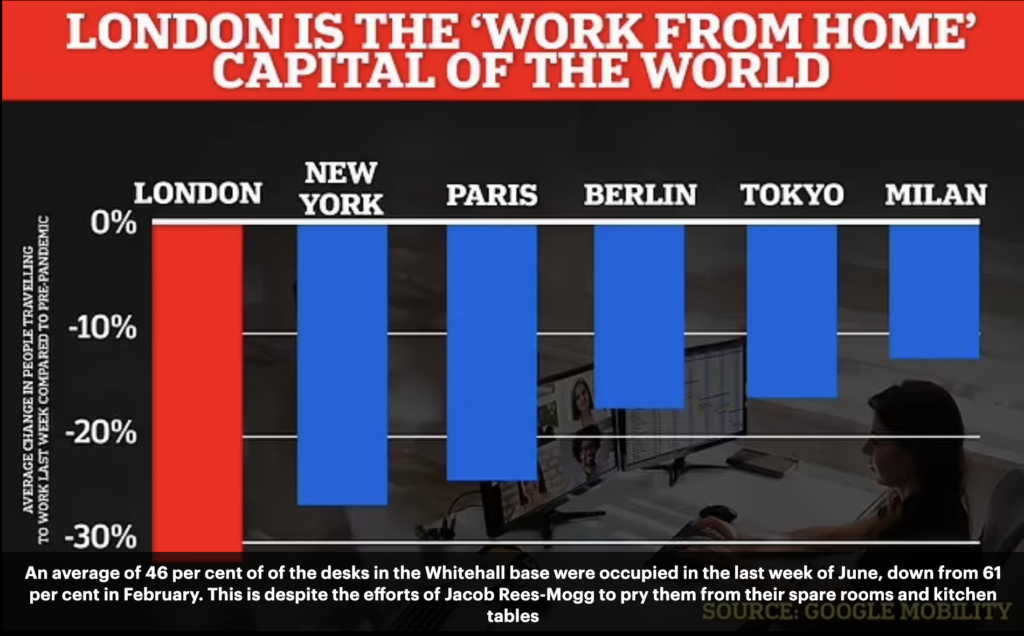
An average of 46% of of the desks in the Whitehall base were occupied in the last week of June, down from 61% in February.
This is despite the efforts of Jacob Rees-Mogg to pry them from their spare rooms and kitchen tables.
Mr Rees-Mogg’s attempts to end WFH have so far included conducting spot head counts in offices at Whitehall and leaving notes on empty desks in a move which was branded insulting by unions.
The note, printed on government paper with Mr Rees-Mogg’s title, was left at empty desks and read “I look forward to seeing you in the office very soon”.
As reported in the Telegraph, a Whitehall source said the Home Office had been “dreadful” at returning to work after Covid.
“With backlogs unresolved and public services underperforming, officials who are refusing to go into work as they are expected to are taking taxpayers for a ride,” they added.
The Telegraph reports the latest data on office occupancy reveals that almost every department has brought more staff back to the workplace since Rees-Mogg’s crackdown.
The Department for Work and Pensions has increased its numbers from 32% at the start of February to 56% at the end of June, while the Department for Business, Energy and Industrial Strategy was up 59% from 27%.
Worth reading in full.
To join in with the discussion please make a donation to The Daily Sceptic.
Profanity and abuse will be removed and may lead to a permanent ban.
If they’re not doing their job, find out what the problem is.
If it isn’t their problem, fix the problem.
If it’s their problem and they won’t/can’t work to overcome whatever the problem is, sack them.
Who cares whether they’re WFH or not?
It’s called the free marke-
….ah, yes, I see the problem there.
OK, “sack” is a bit strong – first figure out if there’s anything else to which they’d be better suited, obviously. And “COVID MARSHALL” is not a valid occupation.
What is with the downvotes? This isn’t an indiscriminate attack on all Civil Servants, or support of brutal employment tactics, or anything like that. Please elaborate! Here we engage, we debate, we find the truth, together. If you can’t do that, you’re too soft for Daily Sceptic and you need to get back to “Your BBC”!
Damn right Joe. One of my posts complaining that my troll hadn’t appeared to downvote me attracted three downvotes.
Funny but sad. Why do these pillox come here?
Cheers, Hux. How the devil are ya?!
P**s taking slackers, the lot of ’em.
I suspect that during early COVID theatre many moved further from the cities and now would face a long commute
That’s their problem, not ours – the taxpayers who fund their indolent lifestyles.
Surely being work-shy is a prerequisite of being a civil servant?
The two do go hand in hand for a large percentage.
I work from home full time and I’m more productive than I was in the office
Anyone who measures productivity by hours spent at a desk in the office is somewhat lacking in understanding IMO
That’s as maybe. It’s impossible to comment otherwise not knowing your occupation. If you work for a commercial organisation, i.e. a productive part of the economy, that’s a decision to be taken by that company and its shareholders and is no business of anyone else.
But for the non-productive part of the economy, i.e. the snivel serpents, just exactly how do you prove they are more effective WFH? Especially in the face of evidence from the DVLA and the Passport Office that the exact opposite is true?
I agree completely with your sentiments but (and, from experience here, I risk opprobrium), phrases like “snivel serpents” only serve to detract from the argument and make any writer seem childish. Let’s keep the arguments civil (think Rees-Mogg) and remain above the opposition.
It’s Bozo’s fault for drawing up a “Skivers Charter” for the fake pandemic (seasonal flu)
As a former (retired) Civil Servant, I occasionally worked from home in the months leading up to my departure. It basically required me to keep the computer on, monitor it and reply to emails plus keep the mobile handy so that people could get in touch with me if necessary. As I was working my notice, my line manager didn’t take any interest in my performance or what I was actually doing (not that they’d ever done that anyway).
The IT systems in my dept. were unreliable with multiple programmes which didn’t really “talk” to each other. They continually patched updates and the whole system was clunky,slow and frequently froze – even when you were in the office. At home, with slower internet speeds and unreliable provision, it was even worse.
Now multiply that reality by the thousands of CS who are now “working from home” most of the time. It’s no wonder our public “services” are collapsing.
The wfh culture was established in Whitehall long before the lockdowns but nobody really noticed before. It was further aggravated by Government reluctance to ask civil servants to return to work between lockdowns so now it has become embedded. I doubt the trend can be reversed by Rees-Mogg’s notes or even penalties for non-attendance. Introducing an office attendance allowance but for only those willing to do 4 days a week might be a way forward. The problem with the draconian approach is too much hot air and not enough practical solutions.