
Europe’s Inflation Rate Is Soaring Thanks to Bad Policy
In April, the UK’s inflation rate reached 9% – which is four and half times greater than the Bank of England’s ‘inflation target’. What’s more remarkable, though, is that 9% is low by comparison to some other countries in Europe.
In the latest month for which data were available, the inflation rate reached 10.7% in Hungary, 11.3% in Greece, 14.4% in Bulgaria, 18.9% in Lithuania and an astonishing 20% in Estonia! Even notoriously inflation-phobic Germany logged a rate of 7.9% in May – the highest in decades.
You have to see the numbers plotted to fully appreciate what’s happening. Here’s Germany’s inflation rate over the last 25 years:
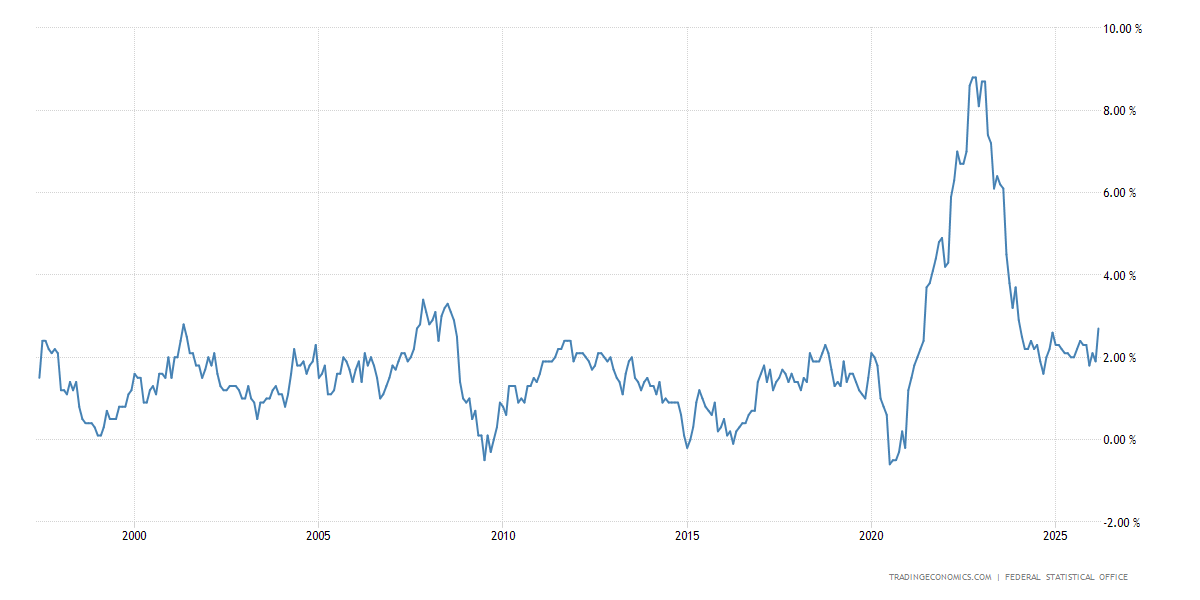
The rate hadn’t gone above 4% since the early 1990s. Now, in just the last eighteen months, it has reached double that level. The same is true for the Euro Area as a whole – where the latest monthly figure was more than 8%.
Europe’s sky-high inflation rates are partly the fault of supply-chain disruption during the pandemic. However, that’s far from the whole story. After all, some developed countries are still reporting quite low inflation rates: Japan’s is 2.5% and Switzerland’s is 2.9%. Even Australia – which endured more days of lockdown than Europe – has a rate of ‘only’ 5.1%.
The major culprit, of course, is the rising cost of energy – a trend which began last year, and has been exacerbated by Russia’s invasion of Ukraine. Indeed, one can’t help but notice a strong correlation within Europe between dependence on Russian energy and the current rate of inflation (though Finland, oddly, is an exception).
As I noted before, a lesser-known reason for sky-high fuel prices is lack of refining capacity. Dozens of refineries were shuttered during the pandemic, when demand for oil was way down. And it seems that no one bothered to think about the consequences once demand for oil picked up.
One major reason companies haven’t been upgrading their refineries, or building new ones, is the global shift away from fossil fuels. Why risk millions on a new refinery when governments are pursuing “Net Zero by 2050”? Note: refineries aren’t the kinds of things you can put up or take down at your convenience – their expected lifespan is on the order of decades.
Even if “Net Zero” is a worthy goal, rushing toward it without care for consequences is surely self-defeating: any policy that contributes to soaring inflation is unlikely to remain in place for long.
To join in with the discussion please make a donation to The Daily Sceptic.
Profanity and abuse will be removed and may lead to a permanent ban.
Or is it the controlled collapse of the West by our friends at the WEF and CCP?
I keep saying, “Watch for the digital currency,” which is a euphemism for banning cash. Once all of our “our” money is controlled by the government, they control everything in our lives. Whenever they want “our” money, they can take it. Whenever we do something that is not authorized we will have our money taken. Plus, they can bribe the masses by depositing stimulus and minimum monthly incomes into these accounts.
At one time, I thought this was the stuff of wacko conspiracy theories. Now I think it’s almost inevitable.
Well, at least that’s chapter and verse for the idiots who have tried to link UK inflation to leaving the EU rather than lockdown.
Yes, it’s own goal after own goal. I will enjoy Europe’s demise, even though I’ll be freezing and starving to death while it’s occurring. I’m giving the EU about a year; it was a nice idea, but sadly implemented by the very worst people in the world, and we’ll all remember that brief interwar period when the continent attempted to homogenise itself, against its own interests, as a kind of technocratic financial construct for the benefit of the 1%.
Some friends, who should have known better, were pontificating about how awful that the Ukraine war was causing so much inflation. I showed them the chart showing not a blip in the inflationary trajectory with the start of the war. Not sure it registered with them.
I would just add that the reported inflation rates are reported to us by the government, governments which have been know to manipulate data in the past if it suits their purposes. For example …. pretty much All the Covid data.
It’s well-documented that the formulas used to produce CPI have been “revised” numerous times since the severe inflation of the late 1970s and early 1980s. According to the website ShadowStats, if the same formulas and definitions used four decades ago were used today, inflation would be 2 times or more higher than currently reported. This would mean that the inflation we are living through today is not only the “worse in four decades,” it is very possibly the worst in history in many countries (including the USA).
Put it this way, when my government told me pre-Covid that annual inflation was only around 2 percent, I didn’t believe it. As some will recall, the big narrative 28 months ago was actually that inflation was “too low.” The Fed and economists wanted MORE inflation …. Well, they got their wish.
As mentioned above, I was “skeptical” of the validity of the official inflation numbers even three years ago. While working on a freelance piece on “shrinkflation,” (where manufacturers shrink the size of packages to conceal real inflation), I hit upon the idea of calculating REAL INFLATION by tallying all the “workarounds” families and citizens had to employ to deal with this supposed “very low” or “non-existent” or “transitory” inflation. Price inflation is really a measure of how far your dollars stretch compared to a prior point in time. If price inflation is rising, one’s income has to rise by just as much to maintain “a constant standard of living.” If this does NOT happen, families have to cut back somewhere to “make ends meet.” Enter inflation “workarounds” – which I defined as all the steps families have to take to get to the end of the month without going into the red. As I learned with a pretty exhaustive research project, the number of such “workarounds” had increased dramatically. Here are some of the workarounds people began to use to deal with inflation (I know many of these applied to me and my family). Shopping more at “discount” stores like… Read more »
You probably wouldn’t believe it, but this paints a fairly rosy picture of the USA. Eg, I haven’t seen something like a full-service filling station for more than 30 years in either Germany or England, while your article has a strong undercurrent of That’s really how it ought to be.
🙂
There’s one full-service gas station left in Alabama. I did a story on it once.
But, yes, the move to “self-service” was a “work-around” as well. We don’t even have gas stations any more. We have convenience stores which sell gas.
Once upon a time, many teenagers’ first jobs was at a gas station, filling tanks, checking some housewives’s oil, washing the windshields, etc. Those jobs are gone … a victim of … inflation and workarounds!
… BTW, we have very few “housewives” left either. Housewives had to go get a job for a family to maintain that “constant standard of living.” Millions of women entering the workforce might have been the first big “workaround.”
I remember one full-service gas station which operated at a bridge in my home town. It closed before I left school (1991) and I haven’t seen one anywhere since. The idea that such a thing still exists somewhere has a pleasantly nostalgic feel.
As to the housewives, that’s a bit culture dependent: There are probably not many housewives left in German or English middle-class families. But that’s very much different for Poles. AFAICT, married muslim woman usually don’t work (for money — running a household is a lot of work) either and the same seems to be true for Indians.
As you can probably tell, I’m intrigued by this topic (inflation). I’ve come to think that EVERYTHING that happens in the world has something to do with it – at the government level, family level, corporate level, etc. … At some point, we are going to start running out of “workarounds” that actually work.
“Workarounds” are no doubt affecting this site and this message board. As I pointed out in my article on this topic, one of the most common “workarounds” to deal with inflation is people cutting out or cutting back on paid subscriptions. That is, if inflation was “non-existent” or “no big deal,” more people would be subscribing to excellent sites like this.
This site is now also soliciting advertising. I used to sell media advertising. I know from first-hand experience that when economic times get dicey, businesses … cut back or eliminate on advertising. So those people who are selling advertising today have a tougher time of it than they did 10 or 20 years ago. (There are also far fewer locally-owned “Mom and Pop” type businesses).
In fact, the biggest advertiser of them all these days is … Big Pharma. So it’s a great “tell” to see what industry can still afford to spend huge amounts on advertising (although I think most of these media campaigns are really pay-offs to buy favorable coverage). I actually think if Big Pharma wasn’t subsidizing all of these mainstream sites, half of them might already be out of business.
What differentiates the internet from traditional media outlets is that it’s interactive instead of just being an awe-inspiring spectacle raining down on a silent, open-mouthly gawping audience. Spending two years with building a community only to eliminate it on the grounds that it’s just a bunch of useless leeches is therefore probably not a smart business move. Time is not free as we all have only a limited supply of it. And some people might well not have anything else they could offer.
Now I wonder what’s behind all this inflation?
It couldn’t be crashing the economies in order to impoverish the plebs, create massive household debts and then “reluctantly” and with a “heavy heart” bring in CBDC and UBI, could it?
No of course not, that’s a nut jobbers conspiracy theory.
Ron Paul is one of my political heroes. Paul, a doctor, went into politics after Nixon “closed the gold window” (and created the “petrodollar”) because Paul was certain this transition to “Monopoly money” was going to one day lead to run-away inflation and the debasement of the currency. Real inflation was/is his most prominent political issue. Of course, few people listened to him. Paul also warned about the growing military industrial complex and all these wars (I mean, “interventions”), which he said would do nothing to protect America’s national security or enhance citizens’ “freedoms” … but they would produce even more … inflation and staggering levels of debt. He warned about the growth of the Surveillance State and the eradication of civil liberties (including Orwellian censorship). His political incorrectness was also illustrated by the fact that he long proposed de-criminalization of marijuana, arguing on libertarian grounds that adults could use a drug if they wanted to (my body, my choice) and this drug happened to be far safer than alcohol. As it turns out, most people came around to this view as marijuana possession is now legal in about half of the U.S. states. But this is actually an inflation “workaround”… Read more »
Outside of certain, fairly limited industrial applications, gold is not valuable. It’s just something whose supply is limited and which is therefore usable as universal exchange medium, ie, something which symbolizes an abstracted value. One can as well use gravel for that provided the amount of gravel that’s circulating can be controlled. An ubuitous product will always be cheaper than a rare one because a multitude of suppliers are competing for a limited number of buyers and lowering prices is one way of attracting them. Pandemic policies have grossly increased the supply of the product legal tender, hence, it’s real-world value as exchange medium in order to obtain other goods of value has gone down. Actually, this has been going on since the so-called financial crisis of 2008, when quantitative easing, ie, give freshly created money to entities which have overloaded themselves with debt so that they don’t have to default on it, was invented as miracle cure for saving entities which had overloaded themselves with debt. Meanwhile, we are experiencing government defaulting on their debts. Obviously, this starts to happen at the fringes and not in places whose currency people who live from currency speculation love to have most.… Read more »
Gold has stood the test of time as money for many reasons, not just the one you mention.
JP Morgan himself said gold and gold alone was real money.
Gold has no intrinsic value except as conductor of electricity (simplification). It’s considered valuable simply because it’s relatively rare and people generally like the look of it.
Several countries are scrambling to have “their” gold stored in vaults in London or New York “repatriated” because they think it looks pretty? The reason Nixon “closed the gold window” was because DeGaulle wanted the option of getting payment for American debts in gold instead of dollars. He must have thought it was more than a pretty trinket. Venezuela was sunk by sanctions and tried to get its gold back and was told, “sorry. we’re going to keep it.” Russia and China have been acquiring huge amounts of gold for years. Nobody knows how much these nations really have, nor does anyone really know how much gold America actually has. All of this is happening because gold is still considered “real money” … just like it was 500 years earlier. When hyper or rampant inflation comes, people and nations that own physical gold will be in far better position than those who hold pieces of paper with the pictures of dead presidents on it. If you were a jew or a refugee trying to flee Germany before WWII, you could fund your life-saving get-away … with gold (or silver). What has happened in the past will happen again in the… Read more »
“In April, the UK’s inflation rate reached 9% – which is four and half times higher than the Bank of England’s ‘inflation target’.”
I think the author meant to write four and half times as high or three and a half times higher. The elementary mistakes by journalists make one wonder if they even try to understand what they write and are there no sub-editors these days?
There are probably no editors. All newsrooms have had massive layoffs by now. One would think that after 15 years of continuing layoffs – and 15 years of declining advertising and subscription sales – that someone left in the newsroom might conclude that “maybe the economy is not so rosy after all. Didn’t this room used to have 20 other journalists in it?”
This isn’t the BBC where they have three people doing the work that should be accomplished by a single person.
Net zero is not a worthy goal, its an act of self-harm.
Inflation began long before the Russian invasion of Ukraine, it is the direct result of lockdown policies and the rise of government debt. I am disappointed that the DS would use the facile Joe Biden – “its all Putin’s fault” – line of argument.
..I agree ‘Putin’s Price Hike’…..is total nonsense, and is only meant to deflect the blame away from where it belongs… with them and two years+ of economic Hara-Kiri. Two things strike me here, are they genuinely trying to tell me that one country, Ukraine, has been why the ‘markets’ thrive and it’s the one country that ‘controls’ the world? I don’t think so… Secondly it deflect away from another real problem, the West’s Sanctions on Russia and Belarus, which aren’t working to stop Russia, but are making everyone’s lives a ‘self-imposed’ misery…and it will only get worse. Not just for richer countries …..this is what UN Secretary General Antonio Gutierrez has said recently…” “There is really no true solution to the problem of global food security without bringing back the agriculture production of Ukraine and the food and fertilizer production of Russia and Belarus into world markets despite the war.” These blunt words by UN Secretary-General António Guterres accurately describe the present global food crisis. As the U.S. and the G7 (comprising Canada, France, Germany, Italy, Japan, the United Kingdom, and the United States) insist that cutting off food exports from Ukraine poses the biggest threat to world food security, rather than… Read more »
“Even if “Net Zero” is a worthy goal”, except it isn’t of course. There is zero evidence that man’s approx 3% of total CO2 controls temperature or climate. There’s even no evidence of the totality of the ~0.04% of CO2 in the atmosphere having any effect on them.