
Early Closure of Bars and Restaurants Had No Impact on the Spread of Covid in Japan
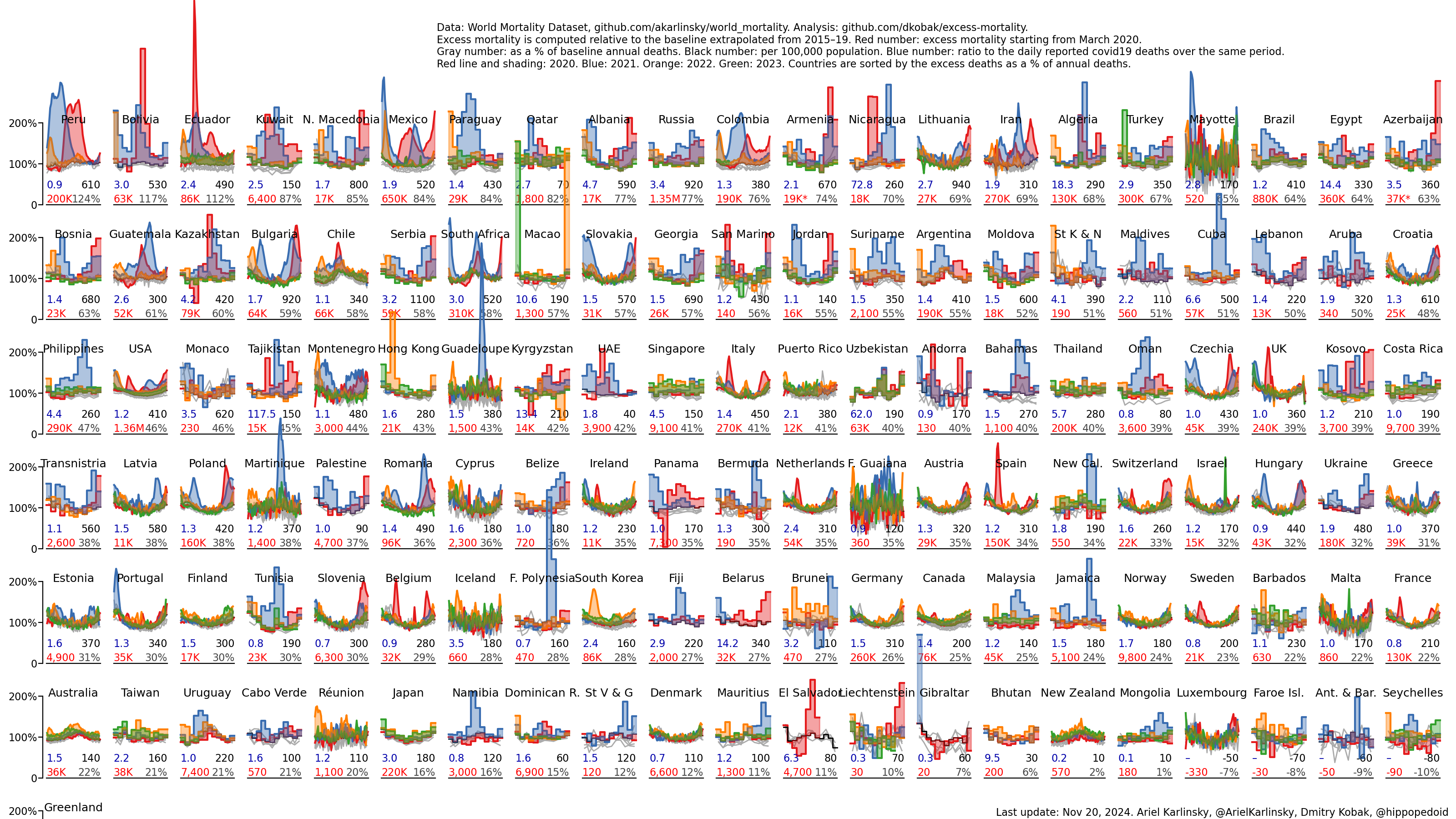
When comparing the impact of Covid in different countries, Japan is a clear outlier. In 2020, the country had zero days of mandatory business closures and zero days of mandatory stay-at-home orders. Despite seeing less change in mobility than major European countries, Japan has not had any excess mortality since the pandemic began.
As you may recall, the country hosted the Summer Olympics between 23rd July and 8th August. But even that did not lead to a large number of deaths. It has been suggested that Japanese people, and perhaps East Asians in general, have some degree of prior immunity to the virus.
In January of this year, Japan introduced restrictions on businesses for the first time. Specifically, 11 prefectures (including the capital, Tokyo) prohibited bars and restaurants from selling alcohol after 7pm, and forced them to close at 8pm.
In a recent preprint, Reo Takaku and colleagues investigated the impact of these measures on the spread of Covid. They began by checking whether the measures had their intended effect – of reducing the number of people frequenting bars and restaurants. This cannot be taken for granted: the night curfew in Greece had virtually no impact on mobility.
The researchers analysed survey data collected in the autumn of 2020 (when there were no restrictions in place) and the winter of 2021 (when there were restrictions in place). As the chart below indicates, the measures do appear to have had their intended effects.
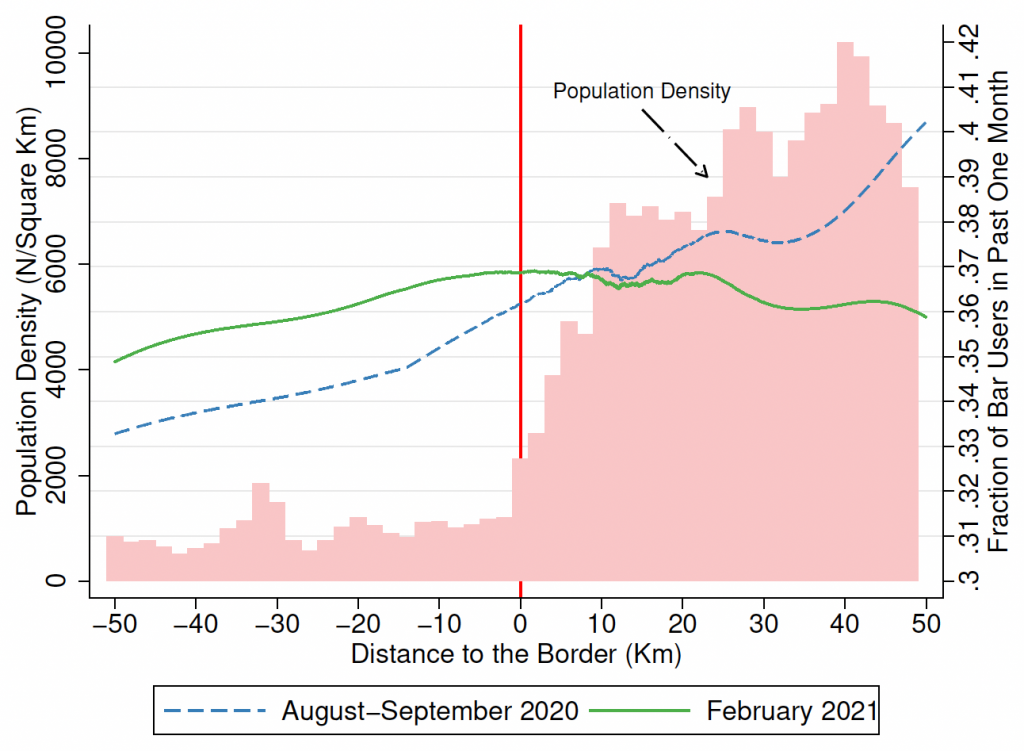
The x-axis represents how far respondents lived from the border of a prefecture that introduced restrictions. The blue and green lines (corresponding to the right-hand y-axis) show the fraction of people who went to a bar or restaurant at least once in the relevant month.
The blue line corresponds to the autumn of 2020, and the green line corresponds to the winter of 2021. Notice that the green line is substantially flatter than the blue line, but only on the right-hand side of the chart. This suggests that restrictions did reduce the number of people frequenting bars and restaurants.
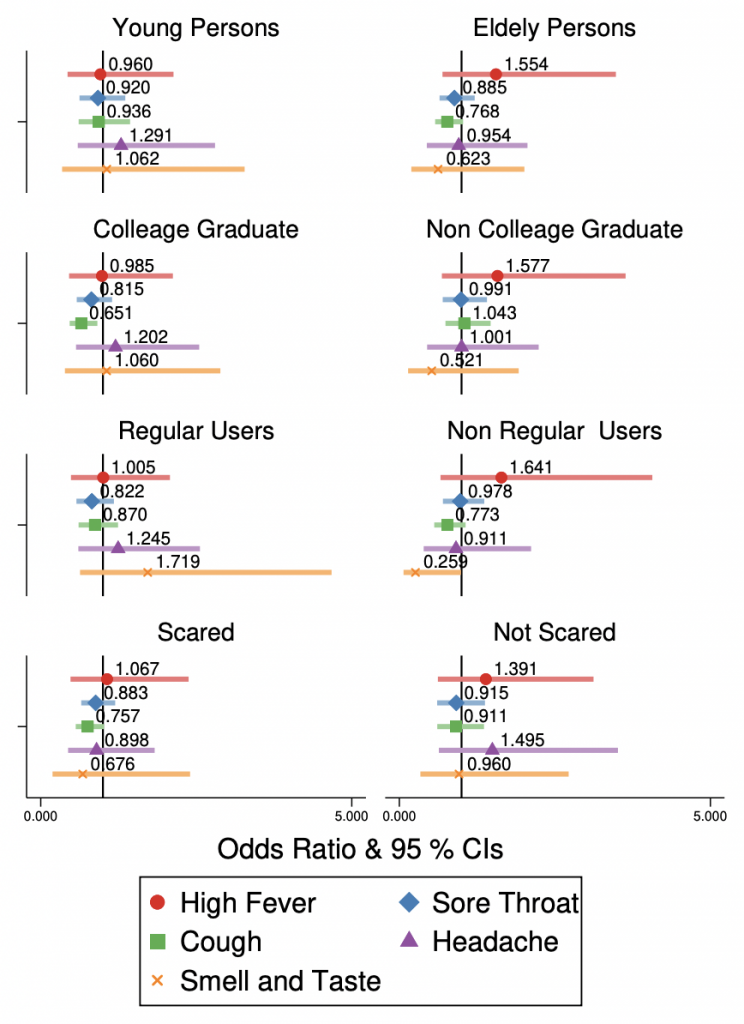
Next, the researchers examined whether the measures actually reduced the spread of Covid. To do this, they compared self-reported symptoms among individuals living either side of the border of a prefecture that introduced restrictions. They also controlled for a number of characteristics, such as age, marital status and household income.
As the chart below indicates, they found no evidence that the measures reduced the spread of Covid. Individuals living under restrictions were no less likely to report Covid symptoms than their counterparts on the other side of the border. This was true even for young people, and those who regularly used pubs and restaurants.
One plausible explanation for Takaku and colleagues’ findings is that people simply socialised elsewhere. Another possibility is that restrictions do not have additive effects on transmission; perhaps they only make a difference once practically all public locations are closed (including ‘essential’ ones like grocery stores and pharmacies).
“Given the large detrimental effects on employment,” the authors write, “alternative measures for full-service restaurants and bars should be considered”. And the best alternative measure, I would argue, is returning to business as usual.
To join in with the discussion please make a donation to The Daily Sceptic.
Profanity and abuse will be removed and may lead to a permanent ban.
High fever, sore throat, cough, headache, impaired sense of smell and taste – those are flu symptoms, not only “Covid” (meaning SARSCoV2) symptoms.
There is so much confusion. It’s best not to say that a person “has Covid” unless they have pneumonia that was probably caused by a SARSCoV2 viral infection. That in fact was the definition of “Novel Coronavirus-Infected Pneumonia” (NCIP) that had its name changed by the World Health Organisation to “Covid-19”.
Such usage of words is 100 times more sensible than the current usage encouraged by the state, media, and medical priesthood. But even this leaves aside the question of how to classify people aged 80+ who happened to have tested positive for SARSCoV2 and who also caught pneumonia, possibly bacterially not even virally, in hospital.
“ It’s best not to say that a person “has Covid” unless they have pneumonia that was probably caused by a SARSCoV2 viral infection. “
This is such an important distinction. The misuse of language is so ubiquitous that it has to be deliberate.
It’s like people saying ‘I’ve had the ‘flu’, when they’ve had a couple of days off with a cold. And yet, from official data downwards, people test positive for ‘Covid’.
No danger of the DS being accused of dumbing things down for its readers!
That is one tricky chart to get your head around.
It certainly is. It also leaves me wondering why no, or few “researchers” in the UK can address themselves to these subjects, and instead we end up with nonsense from Ferguson and the serried ranks of psycho and medical “experts”.
Silly me! Of course, no-one here bar a few brave souls would dream of doing or producing anything which may run counter to the official Government “narrative”.
Is the problem that the work isn’t produced or that the work isn’t published or widely communicated?
Difficult to say, but a corollary may be that the possible or probable non-publication or suppression of such work is a deterrent to producing it, if it then has no circulation, the author(s) are subject to opprobrium and smear attacks from the usual Government “attack dogs” and so forth.
Anyone got a PhD in graphology?
Ya learn something new every day, in my attempt at humour I didn’t realize graphology was a thing i.e. study of handwriting, what sad bastard would study handwriting? or graph theory?
How does compelling Japanese bar customers to eke out their last glass of Saki between 7 and 8pm affect anything ?
They probably looked at that time in England when pubs were partly deristricted, most social distancing measures were relaxed but for some unknown reason “drinking up time” was abandoned.
10pm closing was interpreted as ‘everybody out and off the premises by 10pm’ which resulted in scrums of unsated drinkers heading to Tesco Metro for carry outs.
That in turn provided lots of pictures and commentary for media pundits to smear irresponsible drinkers for spreading the Covid.
I’ve been into a number of different workplaces over the last year, that have become obsessed with pinch points. A lot of these hysterical measures have IMO made this even worse
Similarly with the 2 metre rule.
Epidemiological Investigation | Smallpox | CDC
It is the need to ‘Do Something’
Anything.
Typical of politicians the world over.
And the opportunity for them to increase control. As always, it is the fault of the people for putting up with this childish nonsense.
One other explanation, along with pre existing immunity and lifestyle/diet, could be the elderly care home system in Japan. I remember reading a piece last year on how many care homes have a secure system in place to prevent infections, with visiting and communal areas kept apart from residential. If this is accurate, then it backs up focused protection.
Fish and especially oily fish is a big feature in the Japanese diet. What does that contain?
Vitamin D
Loads. I’m on a very restricted diet. I could just about survive on a sardines only diet. This image has been on my phone for months.
I thought I finally got the graph, but actually, I realise I still don’t.
What is minus 20 kilometres to the border of a prefecture?
I didn’t attempt to digest the graphs but I would guess that minus 20k would represent 20 k inside the zone/border?
Even more confusing, what is +20km to -20km from the border?
Is it to do with those to the left of the prefecture and those to the right? North/South?
Minus, before the boarder. plus over the boarder??????????(maybe)
Again the likes of Jay Battachayra and and Sunetra Gupta shown to have been correct from the get go. They said, in the line with all pre pandemic planning guidelines, that closing places like schools or businesses was inadvisable not only because of the costs, but because it is unsound from an epidemiological perspective. Its linear thinking with regard to a complex non linear system.
And anyway, its not evidence based interventions as Carl Henegen has consistently reminded people. Just global experimentation. First on society and its socio-economic structures, now on its individuals and their bodies.
We are sick. Absolutely sick.
No shit Sherlock!
No NPI anywhere had any effect* on the spread of covid.
*Nothing that can be established beyond a reasonable doubt, sufficient to justify the huge costs, financial, social and personal, incurred.
Nothing that can be established beyond a reasonable doubt, ….
Nothing whatsover of benefit can be established, full stop.
I was being generous. Either way, they were wrong and based on the Big Lie that covid was/is exceptional.
Covid like Climate change is a way of shoring up the family finances for the globalists, those billionaires are trillionaires, assuring the future for their grandchildren, not ours
Quelle surprise.
But this is a useful one, Noah.
The spelling, my dears, the spelling!!
As someone who lives in Japan (albeit in a prefecture that did not implement much restriction), I may be able to shed some light. First it is worth noting that when Tokyo implemented the state of emergency and neighbouring Kanagawa/Chiba/Saitama did not a significant number of people travelled the 30 minutes or so on the train to town centers across the border and drank there. Enough that the next thing the governments did was implement train curfews of, IIRC, 10pm for the last trains in Tokyo. While not covered in the report, the post olympics wave resulted in even more ignoring of the state of emergency rules- particularly, but not at all exclusively, by younger people. Since the death toll from that wave was way way lower than previous waves thanks to vaccination that seems to have been a rational choice. Second, Japan had a general policy of isolation for anyone who tested positive. I’m fairly sure that that was the main reason waves died down. They would test anyone associated with people who had tested positive and then isolate those too. Now at the peak of the post olympic wave the isolation was perhaps less good than previously but… Read more »