
Lockdowns Had a Large Negative Impact on Economic Activity in Chile
Some commentators maintain that lockdowns have little or no impact on the economy. They argue it is fear of the virus, rather than government restrictions per se, that causes people to stay at home and stop spending money.
Such commentators tend to rely on studies from the first half of 2020. Because there was a dramatic decline in mobility at the start of the pandemic – when people everywhere stayed at home out of fear – these studies typically find that lockdowns had a small effect on the economy.
However, once the characteristics of the virus became better understood (e.g. that the death rate for those younger than 40 is extremely low), people in jurisdictions not under lockdown began venturing out again. As a result, the damaging effects of lockdown on the economy are only apparent when you examine several months of data.
In a study published in the Journal of Global Health, Chilean researchers examined the economic impact of localised lockdowns in Chile. They exploited variation in the timing and duration of lockdowns across 170 municipalities, comprising 89% of the country’s population.
As a measure of economic activity, the authors used the year-on-year change in monthly VAT receipts, which previous research has shown is strongly related to GDP.
They began by plotting monthly VAT receipts in municipalities that were and were not under lockdown in May of 2020 (see chart below). The blue line corresponds to those that were, and the red line to those that were not.
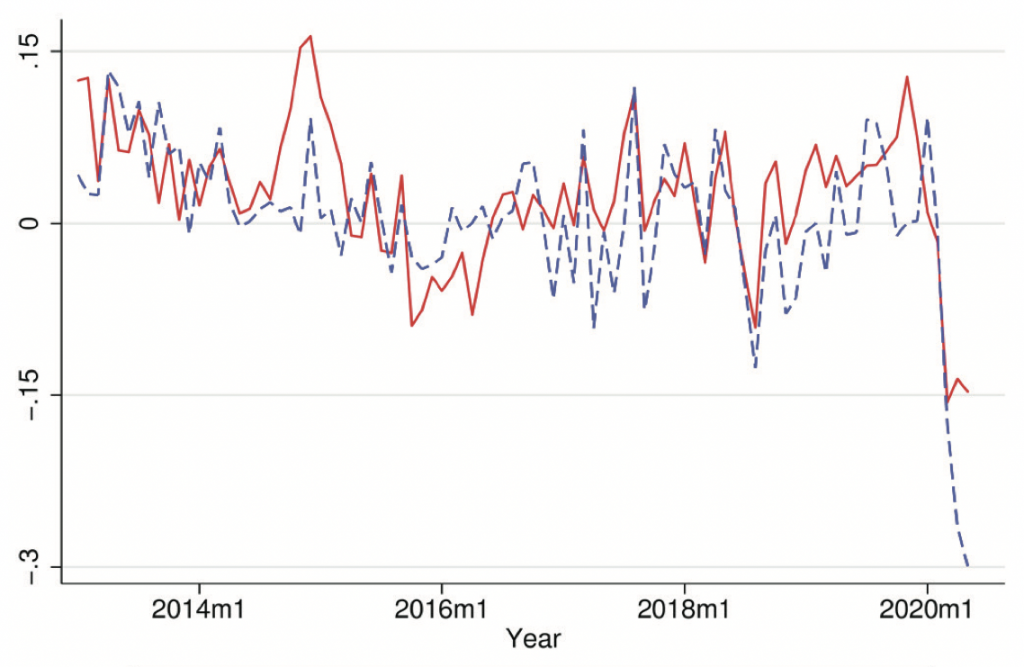
The two series follow similar paths between 2014 and 2019. However, in 2020, the blue line falls substantially further than the red, indicating that lockdowns reduced economic activity over and above the effect of voluntary behavioural change.
To gauge the impact of lockdowns more precisely, the authors ran a statistical model of year-on-year change in monthly VAT receipts, with days under lockdown as a predictor. The model controlled for a variety of factors, including both case and death numbers.
They found that one month of lockdown reduced VAT receipts by 12.5%. Since municipalities without a lockdown saw VAT receipts fall by 15%, this means that lockdowns explain almost half the decline in economic activity.
“Our estimates”, the authors note, “suggest that a three-to-four-month lockdown would reduce economic activity by approximately the same amount” as one year of the 2009 Great Recession. So much for the claim that lockdowns don’t harm the economy.
To join in with the discussion please make a donation to The Daily Sceptic.
Profanity and abuse will be removed and may lead to a permanent ban.
I think you’re preaching to the converted!
what!!? Shutting down an economy has had a negative effect on that economy – well no one could have predicted that unforeseen consequence!
Presumably the leaders in Chile studied PHE at Oxford.
Quite, if tourism + hospitality + most retail are closed then that’s a rather large section of the economy. To claim closing all of that has no effect beggars belief.
Watch the National Debt go up before your eyes
https://www.nationaldebtclock.co.uk/
If the debt was £1.2 trillion before the scam started and then they borrowed an additional $450bn how is it now £2.5 trillion?
(They spent it on wallpaper is not a valid answer)
Who’s getting the interest on the other side of that?
When you see you’ll work out who’s making the lockdown shakedown happen.
Heads They get subsidies, tails you get taxed,
I think its time we stopped talking a about how lockdowns are ineffective. That’s already been debunked. Time to talk about what exactly the agenda is and how to stop it. For example if this website is simply keen on unwinding lockdowns by promoting vaccinations then I’m afraid you have totally missed the big picture. You will never be as free as you were pre-covid unless we start opening people’s eyes.
Slow day at the LS news desk?
Anyone who believes that this nonsense of lockdowns doesn’t harm this, or any other country’s economy, is profoundly stupid. Quite apart from the ad hoc reductions in consumer spending, and the equally ad hoc massive increases in government debt, none of this is a temporary or passing financial setback for everyone.
It is patently obvious that the economic effects of the past 14 months of lockdowns, stop-goes and the rest, plus whatever else may be in the offing, have yet to be felt in the short term e.g. when furlough ends and the brown stuff hits the fan, and maybe even the consciousness of pro-lockdowners. Worse, the long-term effects are likely to be measured in decades, and will make the 2008 and onward recession and years of Osborne austerity look like a Golden Age of Prosperity.
Perhaps, when people see their taxes soaring and their services dwindling (as has already been threatened in local government), they might not be so keen. However, the 60% who are so “frit” that they say they want yet more of this societal and financial lockdown destruction also appear so dim that nothing will convince them.
MMT Magic Money Tree Modun monutree theeree really is trying to fly a bucket by pulling the handle.
Printing and borrowing money. At the moment, the fruit is cascading off the MMT, but soon that harvest will be over, the leaves will turn brown and drop off, and the tree will be forever cankered or dead.
They measure velocity of money and don’t care whether it’s coerced or reciprocated…
I wonder how long the MMT idiocy can be maintained?